
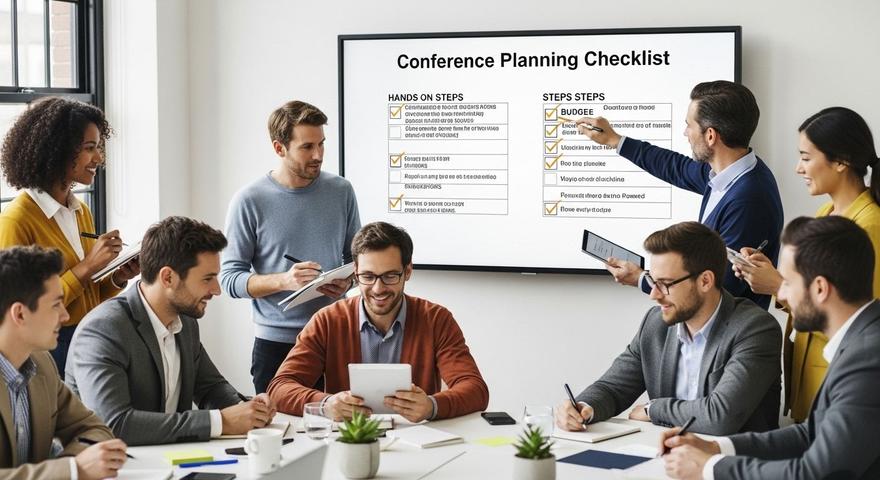
Comprehensive Conference Planning Checklist for Success
Planning a conference sounds simple enough. Set a date, pick a place, invite people. But studies reveal that professional event planners recommend crafting detailed audience personas and using more than ten data points before even booking a venue . The real surprise? The secret to a standout conference often starts long before the first invitation is sent. Instead, it hinges on setting crystal clear objectives and understanding your audience right down to their motivations and possible barriers.
Table of Contents
- Step 1: Define Your Conference Objectives And Audience
- Step 2: Create A Detailed Budget Framework
- Step 3: Select An Appropriate Venue And Date
- Step 4: Develop A Comprehensive Agenda And Schedule
- Step 5: Coordinate Logistics And Resources
- Step 6: Evaluate Success And Gather Feedback
Quick Summary
| Key Point | Explanation |
|---|---|
| 1. Define clear conference objectives | Establish specific goals to guide planning and decision-making, ensuring alignment with audience needs and organisational aims. |
| 2. Develop a detailed budget framework | Categorise expenses meticulously, anticipate costs, and explore revenue projections to ensure financial feasibility and accountability. |
| 3. Select an appropriate venue and date | Assess venues for accessibility, technology, and compatibility with attendee preferences, while choosing dates that avoid conflicts. |
| 4. Create a cohesive agenda and schedule | Structure the agenda for logical flow of information and balanced engagement, ensuring transitions between sessions are smooth and maintained. |
| 5. Evaluate success and gather feedback | Implement multifaceted evaluation methods to measure attendee satisfaction, learning outcomes, and overall effectiveness for future improvements. |
Step 1: Define Your Conference Objectives and Audience
Successful conference planning begins with crystal clear objectives and a well defined target audience. This foundational step determines the entire trajectory of your event, influencing everything from venue selection to marketing strategies.
Start by conducting a strategic planning session that uncovers the core purpose of your conference. Are you aiming to share industry knowledge, facilitate networking opportunities, launch a product, or deliver professional development training? Each objective demands a unique approach and will significantly shape subsequent planning decisions.
Carefully mapping your target audience requires deep understanding of their professional demographics, learning preferences, and engagement expectations. Consider critical parameters such as career levels, industry sectors, geographical locations, and specific professional development needs. Professional event planners recommend creating detailed audience personas that capture not just demographic information, but also motivational drivers and potential participation barriers.
The process of audience identification involves comprehensive research. Engage with potential attendees through preliminary surveys, industry association insights, and professional network consultations. Look beyond surface level characteristics and explore nuanced aspects like career aspirations, technological comfort levels, and preferred learning formats.
Documenting your conference objectives should include measurable outcomes. These might encompass:
- Total number of anticipated attendees
- Specific knowledge transfer goals
- Networking connection targets
- Post event skill enhancement metrics
- Anticipated revenue or cost recovery targets
By establishing precise objectives and thoroughly understanding your audience, you create a robust foundation for a strategically designed conference that delivers exceptional value to participants. Your meticulous groundwork will translate directly into higher attendee satisfaction, more impactful content delivery, and ultimately a more successful event.
Verify your objective setting by asking critical questions: Can your objectives be clearly articulated? Are they specific, measurable, and aligned with broader organisational or industry goals? Does your audience research provide genuine insights that will inform event design? If you can confidently answer these, you have successfully completed this crucial first step in conference planning.
Step 2: Create a Detailed Budget Framework
Building a comprehensive budget framework transforms conference planning from a conceptual vision into a financially viable reality. This critical step requires meticulous attention to detail and strategic financial forecasting that balances ambitious event goals with fiscal responsibility.
Begin by categorising potential expenses into granular segments that capture every potential financial requirement. Major budget categories typically include venue costs, technology infrastructure, speaker fees, marketing expenditures, catering, audiovisual equipment, staff support, and contingency reserves. Understanding each category’s potential cost range prevents unexpected financial surprises that could derail your conference planning.
Developing an accurate budget demands thorough research and multiple pricing consultations. Contact potential venues, technology providers, and service vendors to obtain detailed quotes that reflect current market rates. Professional event planners recommend collecting at least three competitive proposals for each significant expense category, enabling you to negotiate effectively and identify the most cost effective solutions.
Financial planning extends beyond simple expense tracking. Incorporate sophisticated revenue projection strategies that might include ticket sales, sponsorship opportunities, exhibition booth revenues, and potential corporate underwriting. Create flexible budget scenarios that account for different attendance levels and potential economic fluctuations.
Your budget framework should include critical financial safeguards:
- Minimum 10% contingency allocation
- Precise tracking mechanisms
- Clear payment milestone schedules
- Defined fiscal approval processes
- Transparent reporting protocols
Digital spreadsheet tools like Microsoft Excel or Google Sheets provide robust platforms for dynamic budget management. These applications allow real time updates, collaborative editing, and sophisticated financial modelling that adapts to changing conference requirements.
Verify your budget framework by confirming you have comprehensive cost coverage, realistic revenue projections, and sufficient financial flexibility. A well constructed budget serves not just as a financial document, but as a strategic planning instrument that guides every subsequent conference planning decision.
The following table summarises budgeting tools and resources mentioned in the article, outlining their main functions and how they support financial planning during conference organisation.
| Tool/Resource | Main Function | How It Supports Budgeting |
|---|---|---|
| Microsoft Excel | Dynamic spreadsheets for budgeting and modelling | Enables real-time updates and collaboration |
| Google Sheets | Cloud-based budgeting and data sharing | Supports collaborative editing and access |
| Vendor Quotes | Itemised cost estimation | Informs realistic budget setting |
| Contingency Allocation | Reserve funds for unexpected costs | Ensures financial flexibility and security |
| Payment Schedules | Timeline for payment milestones | Supports cash flow and accountability |
| Reporting Protocols | Standard process for budget reporting | Enhances transparency and fiscal oversight |
Step 3: Select an Appropriate Venue and Date
Selecting the right venue and date represents a pivotal moment in conference planning that can significantly impact overall event success. This crucial step requires strategic thinking that balances logistical practicalities with attendee convenience and organisational objectives.
The venue selection process demands comprehensive evaluation beyond simple spatial considerations. Professional event planners recommend developing a comprehensive venue assessment matrix that captures multiple critical dimensions. Consider factors such as geographical accessibility, transportation links, technological infrastructure, parking availability, accommodation proximity, and overall professional ambience that aligns with your conference’s professional profile.
Date selection requires intricate calendar navigation that accounts for multiple competing priorities. Examine industry calendars, academic schedules, regional business cycles, and potential scheduling conflicts that might reduce attendee participation. Peak travel seasons, holiday periods, and competing professional events can dramatically influence attendance rates and overall event momentum.
Technological readiness represents another fundamental venue selection criterion. Modern conferences require sophisticated audiovisual capabilities, robust internet connectivity, flexible presentation spaces, and seamless technical support infrastructure. Conduct thorough site visits that include comprehensive technical assessments, ensuring the venue can support your specific conference requirements.
Your venue evaluation should incorporate these critical verification points:
- Capacity matching anticipated attendee numbers
- Comprehensive technical infrastructure
- Accessibility for diverse participant needs
- Competitive pricing structures
- Flexible booking and cancellation policies
Professional venue sourcing platforms like Cvent can streamline venue discovery processes, offering comprehensive databases and comparative tools. These platforms enable rapid venue identification based on specific conference parameters, reducing research time and expanding potential options.
Verify your venue and date selection by confirming alignment with conference objectives, budget constraints, and anticipated attendee preferences. A meticulously chosen venue transforms from a mere physical space into a strategic enabler of conference success, facilitating meaningful professional interactions and knowledge exchange.
This table provides a checklist for evaluating your venue and date selection, ensuring your choice aligns with all crucial requirements highlighted in the article.
| Checklist Item | What to Verify |
|---|---|
| Capacity matches attendee numbers | Venue can accommodate your expected participants comfortably |
| Technical infrastructure completeness | Venue offers robust AV, internet, and presentation facilities |
| Accessibility | Venue is accessible to all participants, including those with disabilities |
| Competitive pricing | Venue pricing fits within your allocated budget |
| Flexible booking policies | Clear terms for cancellations or changes if circumstances shift |
| Proximity to accommodation | Nearby hotels or lodging available for non-local attendees |
| Transport connectivity | Easy access via public transport or main road networks |
Step 4: Develop a Comprehensive Agenda and Schedule
Crafting a meticulously structured conference agenda transforms a collection of presentations into a cohesive, engaging professional experience. This critical planning stage requires strategic thinking that balances content delivery, participant engagement, and logistical practicalities.
Begin by establishing a clear narrative arc for your conference that guides participants through a meaningful learning journey. Thoughtful agenda design goes beyond simple time allocation, creating intentional knowledge progression that builds momentum and maintains participant interest. Consider the psychological flow of information, ensuring each session builds upon previous discussions and provides logical progression of insights.
Structure your agenda with precision, allocating appropriate time segments for keynote presentations, interactive workshops, networking opportunities, and essential breaks. Professional event planners recommend creating flexible time blocks that accommodate potential variations while maintaining overall event rhythm. Pay careful attention to session transitions, ensuring smooth movement between different programme components that prevent attendee fatigue and maintain high engagement levels.
Technological integration plays a crucial role in modern agenda development. Leverage digital scheduling platforms that enable real time updates, interactive participant engagement, and seamless communication. Digital tools allow dynamic agenda management, permitting last minute adjustments and providing participants with instant access to schedule modifications.
Your comprehensive agenda should incorporate these strategic elements:
- Clear time allocations for each session
- Balanced mix of presentation styles
- Sufficient networking intervals
- Technical setup and transition periods
- Contingency time for unexpected developments
Utilise collaborative scheduling tools like Google Calendar or Microsoft Outlook to coordinate complex scheduling requirements. These platforms facilitate seamless collaboration, enabling multiple stakeholders to contribute and refine the conference schedule.
Verify your agenda’s effectiveness by assessing its alignment with initial conference objectives, potential participant feedback mechanisms, and logical information flow. A well constructed agenda serves as more than a simple timetable it becomes a strategic roadmap guiding participants through a transformative professional experience.
Step 5: Coordinate Logistics and Resources
Coordinating logistics and resources represents the operational backbone of conference planning, transforming strategic vision into practical implementation. This complex stage requires meticulous attention to detail and sophisticated project management skills that synchronise multiple interdependent components.
Professional event coordination demands a holistic approach that anticipates potential challenges and develops robust contingency strategies. Begin by creating a comprehensive resource mapping document that catalogues every logistical requirement, from technical equipment and audiovisual needs to catering, transportation, and staff support. This systematic approach ensures no critical element is overlooked during the planning process.
Technology integration plays a pivotal role in modern logistics management. Utilise sophisticated project management platforms that enable real time tracking, collaborative communication, and dynamic resource allocation. These digital tools transform complex logistical coordination from a potential administrative nightmare into a streamlined, transparent process that allows instant visibility across all planning dimensions.
Effective resource coordination extends beyond physical infrastructure. Consider the human elements of conference delivery, including staff training, role assignments, communication protocols, and potential scenario planning. Professional event managers understand that seamless logistics depend not just on equipment and spaces, but on well prepared teams operating with clear understanding of their responsibilities.
Your logistics coordination should incorporate these critical verification points:
- Comprehensive equipment inventory
- Detailed staff role assignments
- Precise timeline for resource deployment
- Backup systems and contingency plans
- Clear communication channels
Collaborative platforms like Trello or Asana provide powerful tools for breaking down complex logistical challenges into manageable, trackable components. These applications enable real time updates, task delegation, and progress monitoring that simplify the intricate process of conference resource management.
Verify your logistics coordination by conducting comprehensive walk through simulations that test every planned component. A meticulously coordinated logistical framework transforms potential operational chaos into a smooth, professional conference experience that appears effortless to participants.
Step 6: Evaluate Success and Gather Feedback
Evaluating conference success transforms a singular event into a strategic learning opportunity, providing crucial insights that inform future planning and continuous improvement. This final step represents more than a routine assessment it is a comprehensive analysis that decodes the intricate dynamics of your professional gathering.
Effective evaluation requires a multifaceted approach that captures quantitative metrics and qualitative participant experiences. Design feedback mechanisms that go beyond simplistic satisfaction surveys, creating nuanced instruments that probe deeper understanding of participant engagement, knowledge transfer, and overall event impact. Professional event managers understand that meaningful evaluation transcends surface level measurements, seeking to understand the underlying learning and networking outcomes.
Develop a sophisticated feedback strategy that incorporates multiple data collection methods. Combine digital survey tools with structured interviews, focus group discussions, and comprehensive performance analytics. This layered approach provides a holistic view of conference effectiveness, capturing both numerical data and rich narrative insights that reveal the true value of your event.
Technological platforms play a critical role in modern feedback collection. Leverage advanced survey tools that enable real time data gathering, instant analysis, and comparative benchmarking. These digital solutions transform complex feedback processes into streamlined, actionable intelligence that can immediately inform future event planning strategies.
Your comprehensive evaluation framework should include:
- Detailed participant satisfaction metrics
- Learning and knowledge transfer assessments
- Networking effectiveness measurements
- Financial performance analysis
- Comparative benchmarking against initial objectives
Utilise platforms like SurveyMonkey or Google Forms to create sophisticated, customisable feedback instruments that capture nuanced participant perspectives. These tools enable rapid data collection and sophisticated analytical capabilities.
Verify your evaluation process by ensuring comprehensive coverage of all conference dimensions, from logistical execution to substantive content delivery. A meticulously conducted post event assessment transforms each conference from a standalone occurrence into a strategic building block of ongoing professional development and organisational learning.
Transform Your Conference Planning into Seamless Success
You have just explored the essentials of building a successful conference, from defining clear objectives and setting measurable goals, to solving logistical challenges and ensuring smooth coordination. The article highlights how missing details or lack of specialised support can result in last-minute stress, unexpected costs, or poorly matched venues. Achieving your vision takes more than a checklist. You need reliable partners who understand the pressures of time, budget, and stakeholder expectations for flawless experiences.
Jigsaw Conferences removes the complexity and uncertainty from conference planning. We provide personalised venue finding, event management, and accommodation solutions to help you address every step in your checklist. Whether you are struggling to source the perfect venue, secure competitive rates, or manage last-minute changes, our experienced team streamlines your entire process. Explore how our free venue search and booking assistance can save you both time and money. Ready to deliver a standout conference with complete peace of mind? Visit Jigsaw Conferences today and start your enquiry. Experience the advantage of expert negotiation, premium choices, and tailored event support right when you need it most.
Frequently Asked Questions
What are the essential steps in planning a successful conference?
Successful conference planning involves defining your objectives and audience, creating a detailed budget, selecting an appropriate venue and date, developing a comprehensive agenda, coordinating logistics and resources, and evaluating success while gathering feedback.
How can I effectively define my conference objectives?
To define your conference objectives, conduct a strategic planning session to identify the core purpose of the event. Consider goals such as knowledge sharing, networking opportunities, product launches, or professional development, and ensure they are specific, measurable, and aligned with organisational objectives.
What should I consider when selecting a venue for my conference?
When selecting a venue, consider factors such as geographical accessibility, technological infrastructure, parking availability, accommodation proximity, and pricing structures. Ensure that the venue can accommodate your anticipated number of attendees and meets the technical needs of your event.
How can I gather meaningful feedback after the conference?
To gather meaningful feedback, employ a multifaceted approach that includes digital surveys, structured interviews, and focus group discussions. This will provide both quantitative data and qualitative insights regarding participant engagement, knowledge transfer, and overall event impact.
Recommended
- Event Venues: Key Differences for Corporate Events | Jigsaw Conferences
- Event Accommodation Explained: Essential Solutions for Corporates | Jigsaw Conferences
- Event Accommodation Policies – Safeguarding Corporate Success | Jigsaw Conferences
- Venue Capacity Planning: Optimising Events Safely | Jigsaw Conferences
- What to Do if You Need Emergency Housing: A Step-by-Step Guide | Jigsaw Conferences
Jigsaw Conferences Editorial Team
Verified AuthorThe Jigsaw Conferences Editorial Team comprises venue finding experts with over 20 years of combined experience in the events and hospitality industry. Our team includes certified meeting professionals (CMP), venue sourcing specialists, and industry analysts who provide authoritative insights on venue selection, event planning, and corporate accommodation.