
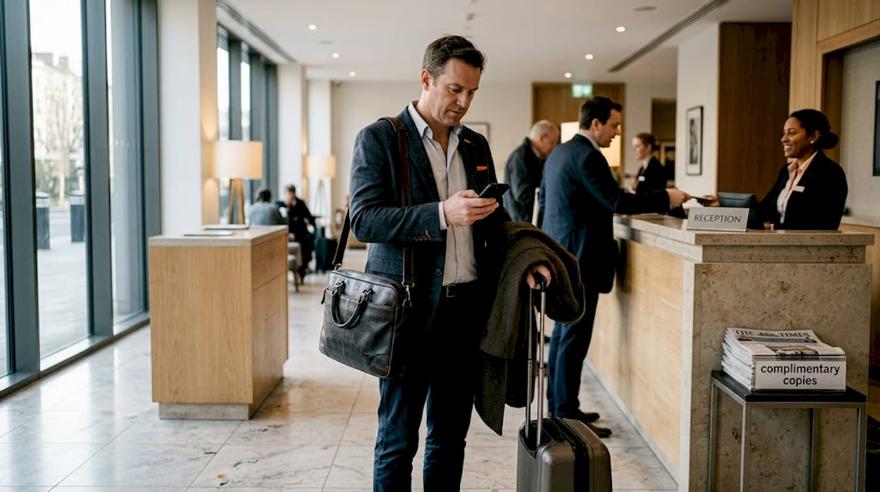
Top business travel accommodation tips for UK managers
TL;DR: Prioritize negotiated rates, proximity, reliable Wi-Fi, and safety when choosing accommodations.Hotels are ideal for short stays, while serviced apartments suit long-term group bookings.Use hybrid pricing models, employee feedback, and expert partners to optimize costs and satisfaction.
TL;DR:
- Prioritize negotiated rates, proximity, reliable Wi-Fi, and safety when choosing accommodations.
- Hotels are ideal for short stays, while serviced apartments suit long-term group bookings.
- Use hybrid pricing models, employee feedback, and expert partners to optimize costs and satisfaction.
Top business travel accommodation tips for UK managers
Choosing the right accommodation for business travel is genuinely one of the most underestimated challenges corporate travel managers face. Too much focus on cost and you risk unhappy, unproductive travellers. Too little, and your budget haemorrhages unnecessarily. Add in last-minute changes, varying city availability, and the sheer volume of bookings to process, and it becomes clear why getting this right demands a proper strategy. This guide cuts through the noise and delivers practical, evidence-backed tips to help you select, compare, and negotiate accommodation more effectively across every type of business trip.
Table of Contents
- Essential criteria for selecting business travel accommodation
- Comparing hotel and serviced apartment options
- Negotiating rates and leveraging dynamic pricing
- Meeting traveller needs: Convenience, technology, and sustainability
- The overlooked value of flexibility and employee feedback
- Streamline your business accommodation with expert help
- Frequently asked questions
Key Takeaways
| Point | Details |
|---|---|
| Location and rates matter most | Company-negotiated discounts and close proximity to offices are the primary drivers of smart business accommodation selection. |
| Match property type to your needs | Use hotels for short, solo trips and serviced apartments for groups or extended stays to maximise value and comfort. |
| Leverage dynamic pricing | Adopting hybrid fixed-dynamic rate models can substantially improve cost control in the UK’s evolving accommodation market. |
| Prioritise tech and sustainability | Next-generation travellers expect digital convenience and eco-certified properties—these are essential, not optional, features. |
Essential criteria for selecting business travel accommodation
Every solid accommodation strategy starts with a clear, prioritised set of selection criteria. Without one, decisions become reactive, inconsistent, and expensive. The good news is that the industry data gives us a strong starting point for what actually matters.
83% of travel managersprioritise company-negotiated rates and discounts when selecting preferred hotels, with 82% emphasising proximity to offices.
83% of travel managers prioritise company-negotiated rates and discounts when selecting preferred hotels, with 82% emphasising proximity to offices.
Those two factors, cost and location, dominate for good reason. A negotiated rate protects your budget at scale, and proximity reduces wasted time and transport costs on every trip. But they are only the beginning. Here is a practical checklist of the criteria that should shape every accommodation decision you make:
- Company-negotiated rates: Always prioritise properties where you have pre-agreed pricing. Even modest discounts compound significantly across dozens or hundreds of bookings annually.
- Proximity to key business sites: Prioritise location within a 15 to 30 minute commute of the office, client site, or venue to protect your travellers’ time and energy.
- Reliable, business-grade Wi-Fi: Slow or unstable internet is not an inconvenience for business travellers, it is a productivity killer. Confirm connection speeds before booking, not after.
- Dedicated workspace: A desk, good lighting, and a quiet environment are non-negotiables for anyone who needs to work in-room. Many budget hotels still fall short here.
- Flexible cancellation policies: Business plans change constantly. Locking travellers into non-refundable bookings creates unnecessary financial risk when meetings are rescheduled or cancelled.
- Safety and security: Particularly relevant for solo travellers or those visiting unfamiliar cities. Confirm the property has adequate security measures in place.
- Onsite or nearby dining options: Travellers who arrive late or leave early need reliable access to food without trekking across a city.
When evaluating key business accommodation features , it helps to score each property against your criteria rather than making a gut-feel decision. A simple weighted scoring matrix, where you assign importance values to each criterion, removes subjectivity from the process.
Pro Tip: Audit non-GDS (Global Distribution System) channels regularly. Many independent hotels and serviced apartments offer better rates and more flexible terms outside the major booking platforms. This is especially valuable in cities like London and Manchester, where GDS availability gaps are common during peak corporate travel periods. For additional hotel tips on what to look for property by property, it is worth building a detailed preferred supplier list that your whole team can reference.
The discipline of applying consistent criteria across every booking is what separates reactive accommodation management from a genuinely strategic programme.
Comparing hotel and serviced apartment options
Once your criteria are clear, the next decision is property type. For most UK corporate travel programmes, this comes down to hotels versus serviced apartments. Each has distinct strengths, and the best choice depends on the nature and duration of the trip.
Hotels are the default option for most business travel, and for short stays they remain excellent. UK hotel ADR rose to £191.55 in 2025, up from £189, with 80.5% of stays being single nights, which tells you the market has optimised heavily for short, transient corporate stays. The convenience factor is real: 24-hour reception, room service, daily housekeeping, and on-demand amenities make hotels a frictionless experience for a traveller who is in and out within 48 hours.
Serviced apartments, on the other hand, come into their own for serviced apartments for business travel scenarios involving longer stays, teams, or events. They excel for groups and long stays, offering full kitchen facilities, separate living and sleeping spaces, and considerably more privacy. For a project team based in a city for three weeks, a serviced apartment can reduce food costs alone by hundreds of pounds per person.
Here is a direct comparison to help you decide:
| Category | Hotels | Serviced apartments |
|---|---|---|
| Best for | Single or short stays (1 to 3 nights) | Extended stays (1 week or more) or groups |
| Facilities | Room service, gym, concierge | Full kitchen, lounge, laundry |
| Pricing flexibility | Dynamic and negotiated rates | Weekly or monthly discount structures |
| Privacy | Limited (shared spaces) | High (private entrance and living areas) |
| Cost per night | Higher short-term convenience premium | Lower on a per-week basis |
| Suitability for teams | Moderate (multiple separate rooms) | Excellent (shared communal facilities) |
For travel managers overseeing accommodation options for UK trips across a variety of trip types, a blended approach almost always delivers the best outcomes. Do not think of hotels and serviced apartments as competitors. Think of them as tools for different jobs.
Pro Tip: In event scenarios where you have a mix of attendees, consider block-booking hotels for managers attending for one or two nights, while reserving serviced apartments for the core team staying for the full week. This hybrid approach keeps costs proportionate to actual stay length while maintaining comfort across the board.
Negotiating rates and leveraging dynamic pricing
Knowing what to book is only half the equation. Knowing how to secure the best possible rate is where significant budget savings are won or lost. Rate negotiation has grown more sophisticated in recent years, and travel managers who keep pace with modern pricing models will consistently outperform those relying on outdated fixed-rate agreements.
The clearest signal from the market is the shift towards hybrid pricing. 60% of travel managers now prefer hybrid fixed-dynamic pricing models, with multi-year requests for proposal (RFPs) and online booking tools (OBTs) growing in adoption, with 74% expecting OBT usage to increase over the next three years. Hybrid pricing blends the security of a negotiated base rate with the flexibility to capture lower dynamic rates when market conditions are favourable.
Here is a step-by-step approach to rate negotiation that works in the current UK market:
- Define your spend targets: Before entering any negotiation, know your total anticipated spend per property and per city. Hotels respond to volume commitments, so a clear spend target gives you genuine leverage.
- Request multi-year RFPs where possible: A two or three year agreement gives the hotel revenue certainty and gives you rate stability. In a market where UK hotel rates are rising year on year, locking in rates early protects your budget significantly.
- Negotiate non-rate terms alongside pricing: Complimentary breakfasts, guaranteed room upgrades, flexible check-in times, and waived cancellation fees can add more value than a modest rate reduction.
- Integrate OBTs into your programme: Online booking tools not only save admin time, they create the data trail you need to demonstrate volume and negotiate better terms in future cycles.
- Review your programme quarterly: Rate agreements made in January may not reflect supply conditions by July. Build in review mechanisms so you can adjust when market conditions shift.
For streamlining payment and contracting , consolidated invoicing and centralised payment solutions also reduce administrative burden and improve visibility across your full accommodation spend.
Pro Tip: Audit both GDS and non-GDS channels for the same properties. Rates can vary significantly between platforms, particularly in London where independent hotel inventory is often priced differently across channels. Working with specialist booking companies for rate negotiations or hotel agency services gives you access to rate intelligence that is simply not visible through standard booking portals.
Meeting traveller needs: Convenience, technology, and sustainability
With budget and property type addressed, the focus shifts to the people actually making these trips. Traveller expectations have shifted noticeably in recent years, and accommodation programmes that fail to keep pace risk poor compliance, low satisfaction scores, and the creep of off-programme bookings.
Gen Z and younger travellers are entering the corporate travel pool in growing numbers, and their expectations are reshaping what good accommodation looks like. Ease of booking matters to 79% of this generation, with 61% prioritising tech-driven experiences, pushing hotels towards hybrid digital and in-person service models. Meanwhile, 57% of travel managers report sustainability gaps in their current hotel programmes, making certified eco-credentials increasingly important in supplier selection.
Here are the must-have features your preferred properties should offer in 2026:
- Digital check-in and checkout: Travellers arriving late after a delayed train do not want to queue at reception. Mobile-enabled access is now an expectation, not a luxury.
- Business-grade Wi-Fi with guaranteed speeds: Not shared Wi-Fi that degrades at peak times. Dedicated bandwidth that supports video calls and large file transfers reliably.
- In-room workspace: A proper desk, ergonomic chair, and sufficient lighting. A surface next to the minibar does not count.
- Rapid travel support: Whether that is a 24-hour reception, a direct contact number, or integration with your travel management platform, quick problem resolution matters enormously when things go wrong.
- Sustainable credentials: Properties with recognised sustainability certifications, such as Green Key or ISO 14001, signal genuine environmental commitment rather than surface-level greenwashing.
Generational shifts and sustainability pressures are fundamentally changing what corporate travellers expect from accommodation. Programmes that adapt now will see stronger compliance and satisfaction in the years ahead.
Generational shifts and sustainability pressures are fundamentally changing what corporate travellers expect from accommodation. Programmes that adapt now will see stronger compliance and satisfaction in the years ahead.
When navigating corporate lodging brands , ask suppliers directly about their sustainability reporting. Many now provide carbon-per-night data, which integrates usefully into corporate ESG (Environmental, Social, and Governance) reporting. For teams with efficient long-stay strategies already in place, layering in sustainability criteria is a natural next step that adds value beyond pure cost management.
The accommodation properties that earn a place in a preferred supplier list today are those combining operational excellence with genuine responsiveness to how business travellers actually live and work.
The overlooked value of flexibility and employee feedback
Most accommodation strategy conversations centre on rates and locations, which is understandable but incomplete. The travel managers who consistently build the most effective programmes are those who treat flexibility and employee feedback as strategic assets, not afterthoughts.
A rigid, price-only focus creates a programme that looks good on a spreadsheet but underperforms in the real world. When a traveller is placed in a property that does not meet their basic working needs, or when a non-refundable booking costs the company money due to a rescheduled meeting, the nominal savings evaporate quickly. The return on investment from building genuine flexibility into booking terms and future-focused options is measurable, not theoretical.
Employee feedback, gathered consistently and acted upon, is arguably the most underutilised tool in accommodation management. Travellers experience properties at a granular level that no sourcing database captures. They know which hotel’s Wi-Fi drops out every evening. They know which serviced apartment has a noise problem on weekends. They know which reception team goes the extra mile when a flight is cancelled. That intelligence is invaluable for programme refinement.
Pro Tip: Schedule quarterly feedback sessions with your most frequent travellers. A short structured conversation, or even a simple survey, will surface amenity gaps and pain points long before they appear in formal complaints or off-programme booking trends. The cost of gathering that feedback is negligible. The cost of ignoring it is not.
Streamline your business accommodation with expert help
Putting these tips into practice takes time, negotiation skill, and access to the right market intelligence. For many travel managers and event planners, that is exactly where an experienced accommodation partner adds tangible value. Jigsaw Conferences has been supporting UK corporate clients since 2003, providing a free venue finding service that covers everything from single-night hotel stays to extended serviced apartment programmes across major UK cities. With established supplier relationships and genuine buying power, the team can source, compare, and negotiate accommodation solutions that match your specific requirements, saving you time and delivering rates that are difficult to access independently. If you are looking to sharpen your accommodation strategy without adding to your workload, it is worth exploring what a specialist service can do for you.
Frequently asked questions
What is the most important factor for selecting business accommodation?
Company-negotiated rates and proximity to the office or client site are typically the two biggest priorities, cited by 83% and 82% of travel managers respectively.
Should I use hotels or serviced apartments for group trips?
Hotels suit short individual stays, while serviced apartments excel for group or extended stays of one to four weeks or more, offering kitchen facilities, privacy, and better per-night cost control.
How can I save money on business accommodation bookings?
Negotiate hybrid fixed-dynamic pricing models, set clear spend-based targets, and audit both GDS and non-GDS channels regularly to surface the most competitive rates available.
What technologies should modern business accommodation offer?
Business-grade Wi-Fi, digital check-in, and a dedicated in-room workspace are now essential baseline requirements for properties catering to corporate guests.
Jigsaw Conferences Editorial Team
Verified AuthorThe Jigsaw Conferences Editorial Team comprises venue finding experts with over 20 years of combined experience in the events and hospitality industry. Our team includes certified meeting professionals (CMP), venue sourcing specialists, and industry analysts who provide authoritative insights on venue selection, event planning, and corporate accommodation.