
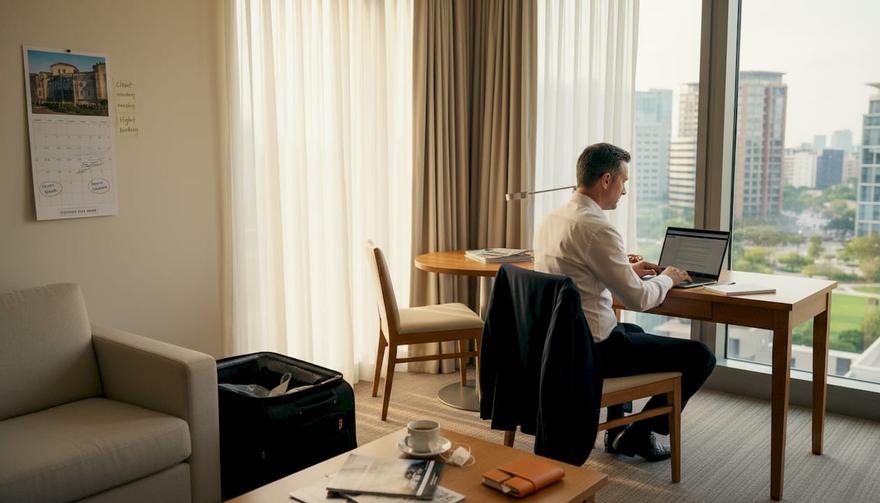
Corporate housing solutions: boost business travel success
TL;DR: Corporate housing offers fully furnished, cost-effective accommodation ideal for long-term business stays.It is particularly valuable for relocations, events, and group project stays, providing flexibility and convenience.Effective procurement and ongoing management are essential to maximize cost savings, safety, and employee satisfaction.
TL;DR:
- Corporate housing offers fully furnished, cost-effective accommodation ideal for long-term business stays.
- It is particularly valuable for relocations, events, and group project stays, providing flexibility and convenience.
- Effective procurement and ongoing management are essential to maximize cost savings, safety, and employee satisfaction.
The UK’s corporate housing market is valued at £1.3bn in 2025 , and it is growing fast. Yet many travel managers and event planners still default to hotels for every business stay, without questioning whether that choice actually serves their teams. Corporate housing has moved well beyond the serviced apartment of ten years ago. Today it represents a structured, scalable approach to accommodation that can cut costs, support employee wellbeing, and align with your organisation’s ESG commitments. This guide walks you through everything you need to know, from defining what corporate housing actually is, to procuring it effectively and measuring the results.
Table of Contents
- What are corporate housing solutions?
- Key use cases: relocations, events and group stays
- How to source and procure effective corporate housing
- Benchmarks, cost control, and measuring success
- The reality: what most guides miss about corporate housing
- Need expert help with your corporate housing?
- Frequently asked questions
Key Takeaways
| Point | Details |
|---|---|
| Beyond hotels | Corporate housing provides greater comfort, value, and flexibility for UK business travel and events. |
| Evidence first | Market growth, ESG, and wellbeing data show clear gains from using serviced apartments over hotels. |
| Procurement matters | A structured RFP process results in safer, more effective housing deals and measurable cost savings. |
| Continuous improvement | Regularly track benchmarks like NPS and cost to maximise the impact of your housing solutions. |
What are corporate housing solutions?
Corporate housing refers to fully furnished, self-contained accommodation arranged for business purposes, typically for stays of a week or longer. Unlike a hotel room, a corporate apartment includes a kitchen, living space, and separate sleeping areas. This makes it far better suited to extended business travel, project-based assignments, or relocations where employees need to feel settled rather than transient.
The distinction from Airbnb or consumer short-let platforms is equally important. Corporate housing providers operate under formal contracts, offer consolidated billing, and are subject to duty-of-care standards that consumer platforms simply do not match. When you are responsible for the safety and comfort of your workforce, that difference is not trivial.
Understanding what is corporate housing in its modern form means recognising a sector that has professionalised considerably. The serviced apartment market is forecast to grow at an 8.8% CAGR over the next several years, driven by demand from multinationals, project-based industries, and event-heavy sectors.
Key benefits for UK corporates include:
- Privacy and comfort: Employees have their own space, which reduces fatigue on long assignments.
- Cost-effectiveness: Group stays and extended bookings typically cost significantly less per night than equivalent hotel rooms.
- Flexibility: Lease terms can be adjusted as project timelines shift.
- ESG alignment: Many providers now offer properties with strong sustainability credentials, supporting your reporting obligations.
In terms of corporate apartment solutions , the UK market features a range of providers. Staycity is currently the largest operator, while platforms such as SilverDoor and AltoVita offer curated marketplace access across hundreds of properties.
“Corporate housing is not simply a cheaper hotel. It is a fundamentally different product designed around the working life of the employee, not the leisure traveller.”
“Corporate housing is not simply a cheaper hotel. It is a fundamentally different product designed around the working life of the employee, not the leisure traveller.”
For travel managers, the practical implication is clear: if your team is staying anywhere for more than five nights, corporate housing should be your starting point, not your fallback.
Key use cases: relocations, events and group stays
Corporate housing earns its value most clearly in three scenarios: staff relocations, business events, and group accommodation for project teams. Each has its own dynamics, but all share a common thread: the need for accommodation that goes beyond a bed for the night.
Staff relocations are where corporate housing has the longest track record. Proximity to the office and access to suitable housing directly reduces stress and supports retention during what is already a disruptive period for employees. A well-chosen corporate apartment near the new workplace gives relocating staff a stable base while they search for permanent housing, which can take weeks or months in competitive UK cities.
Events and conferences generate a different but equally pressing need. When you are coordinating delegates, speakers, and support staff across a multi-day event in London, Manchester, or Edinburgh, block-booking serviced apartments near the venue is often more practical and more cost-effective than negotiating hotel room blocks. Group event accommodation is scalable and can support extended stays for event organisers who arrive days before delegates.
For event staff accommodation , the ability to house teams in the same building or street is a genuine operational advantage. It simplifies logistics, reduces travel time, and keeps your crew focused.
Pro Tip: When booking group accommodation for events, always request a dedicated account manager from your provider. They can handle last-minute changes without the friction of standard booking channels.
Here is a quick overview of how corporate housing maps to common business scenarios:
| Scenario | Typical stay length | Key requirement |
|---|---|---|
| Staff relocation | 1 to 6 months | Proximity to office, workspace |
| Conference delegates | 2 to 7 nights | Central location, group rates |
| Project team deployment | 4 to 12 weeks | Scalable units, flexible billing |
| Event production crew | 3 to 10 nights | Same-building or cluster booking |
For serviced apartments in London and other major UK cities, demand is highest in Q1 and Q3, so booking three to six months ahead for large group requirements is strongly advisable.
A structured approach to booking group stays typically follows these steps:
- Define your headcount, stay duration, and preferred locations.
- Identify proximity requirements relative to your event venue or office.
- Request group rate proposals from at least three providers.
- Confirm billing arrangements and cancellation policies in writing.
- Assign a single point of contact on your side to manage changes.
How to source and procure effective corporate housing
Procurement is where many organisations lose money and time. The most effective approach is a structured request for proposal (RFP) process, even for relatively modest requirements. An RFP forces providers to respond to your specific criteria rather than offering their standard package.
Your RFP should address several non-negotiable areas. Effective procurement must cover demand profiles, pricing matrices, duty of care standards, and ESG commitments. If a provider cannot answer clearly on all four, that tells you something important.
Here is a comparison of the three main procurement routes available to UK corporates:
| Route | Best for | Pros | Cons |
|---|---|---|---|
| Direct booking | Single property, known location | Simplicity, direct relationship | Limited choice, no benchmarking |
| Platform (SilverDoor, AltoVita) | Multiple locations, volume | Wide inventory, reporting tools | Less personalised support |
| Agency (e.g. Jigsaw Conferences) | Complex requirements, events | Tailored sourcing, negotiation power | Requires briefing time |
When vetting any provider, work through this checklist:
- Confirm gas safety and fire risk assessment certificates are current.
- Verify that the property meets your organisation’s ESG reporting requirements.
- Establish whether consolidated billing is available across multiple properties.
- Clarify hybrid pricing options, such as fixed weekly rates versus dynamic nightly pricing.
- Assess the provider’s track record with duty-of-care incidents and how they were handled.
Pro Tip: Ask every provider for a sample management report before signing any contract. If they cannot produce one quickly, their reporting capability in practice will likely disappoint you.
For situations where accommodation is needed urgently, having a pre-agreed emergency accommodation plan in place with a trusted provider is far more effective than scrambling at short notice. Build this into your standard procurement framework, not as an afterthought.
The procurement process is also the right moment to negotiate flexibility clauses. Project timelines shift. Headcounts change. A contract that does not accommodate this will cost you money when reality diverges from the original plan, and it always does.
Benchmarks, cost control, and measuring success
Once your corporate housing programme is running, the question shifts from sourcing to performance. How do you know whether you are getting value? The answer lies in tracking a small number of meaningful metrics consistently.
The headline benchmark is straightforward: aim for 20% or more in cost savings compared to equivalent hotel stays, and track both occupancy rates and average daily rate (ADR) across your portfolio. If your occupancy is consistently below 80%, you are likely over-contracting. If your ADR is climbing without a corresponding improvement in quality, renegotiate.
Key metrics to track on a monthly basis:
- Cost per night versus hotel equivalent: Your baseline comparison.
- Occupancy rate: Target above 80% for contracted properties.
- ADR trends: Watch for unexplained increases quarter on quarter.
- Net Promoter Score (NPS): Survey employees after each stay. A score below 30 warrants a provider conversation.
- Duty-of-care incidents: Any safety or welfare issue should be logged and reviewed.
NPS is often overlooked in corporate travel, but it is one of the most reliable indicators of whether your accommodation programme is actually working for employees. A team that rates their housing poorly will tell you through turnover and productivity, not always through formal feedback channels.
Pro Tip: Build a quarterly review cadence with your provider. Bring your occupancy data, NPS scores, and any operational issues. Providers respond better to structured reviews than to ad hoc complaints.
Cost control also benefits from hybrid pricing strategies. Rather than committing entirely to fixed-rate contracts or dynamic nightly rates, a blended approach gives you predictability for core demand while retaining flexibility for peaks. For emergency accommodation solutions , dynamic pricing agreements with pre-negotiated caps are the most practical arrangement.
Consolidated billing is another underused tool. When all properties across multiple locations are billed through a single invoice, your finance team saves time and your data quality improves. Better data means better benchmarking, which means better negotiating leverage at renewal.
The reality: what most guides miss about corporate housing
Most procurement guides focus on rates and locations. They rarely address the detail that actually separates a good corporate housing programme from a problematic one: the human and compliance layer.
We have seen organisations secure excellent headline rates, only to discover mid-contract that fire risk assessments were out of date, or that the property lacked adequate workspace for employees on hybrid schedules. These are not edge cases. They are predictable failures that stem from treating corporate housing as a commodity purchase rather than a managed service.
The organisations that consistently outperform are those that build genuine relationships with their providers, conduct annual ESG audits, and treat employee feedback as operational data rather than a courtesy exercise. They also plan for the end of events, not just the start. Post-event accommodation for production crews and organisers is frequently left to chance, which creates unnecessary cost and stress.
Understanding the benefits of working with a venue finder extends directly into accommodation sourcing. The same expertise, relationships, and negotiating capability that secures the right event venue also secures the right housing at the right price. Treating these as separate decisions is an inefficiency that experienced planners have long since stopped making.
The uncomfortable truth is that corporate housing done well requires ongoing attention, not a set-and-forget contract. The planners who achieve the best outcomes are those who stay curious, ask harder questions, and never assume that last year’s solution is still the best one available.
Need expert help with your corporate housing?
Whether you are relocating a team, housing delegates for a major conference, or building a scalable accommodation programme for the year ahead, Jigsaw Conferences has been helping UK businesses find the right solution since 2003. Our venue and accommodation sourcing service is completely free to use, and our buying power means you access competitive rates that are rarely available through direct booking alone. We handle the briefing, the provider negotiations, and the ongoing management, so your team can focus on the event or project itself. Get in touch today and let us find the right corporate housing solution for your specific needs.
Frequently asked questions
What are the advantages of corporate housing over hotels for UK business travel?
Serviced apartments offer greater privacy, flexibility, and cost-effectiveness for group or extended stays, along with measurable wellbeing and ESG benefits that hotels rarely match.
How should we evaluate providers for employee relocations?
Prioritise locations close to your office, verify that workspaces are included, confirm flexible contract terms, and always check that fire and gas safety certifications are current before signing.
What cost savings benchmarks apply to UK corporate housing arrangements?
Target at least 20% savings versus hotels and request monthly reports covering occupancy rates and ADR to track performance against that benchmark consistently.
Can we use one provider for multiple UK events?
Yes. Platforms like SilverDoor and operators such as Staycity offer scalable, multi-location arrangements that can be managed under a single contract across several events or sites.
Jigsaw Conferences Editorial Team
Verified AuthorThe Jigsaw Conferences Editorial Team comprises venue finding experts with over 20 years of combined experience in the events and hospitality industry. Our team includes certified meeting professionals (CMP), venue sourcing specialists, and industry analysts who provide authoritative insights on venue selection, event planning, and corporate accommodation.