
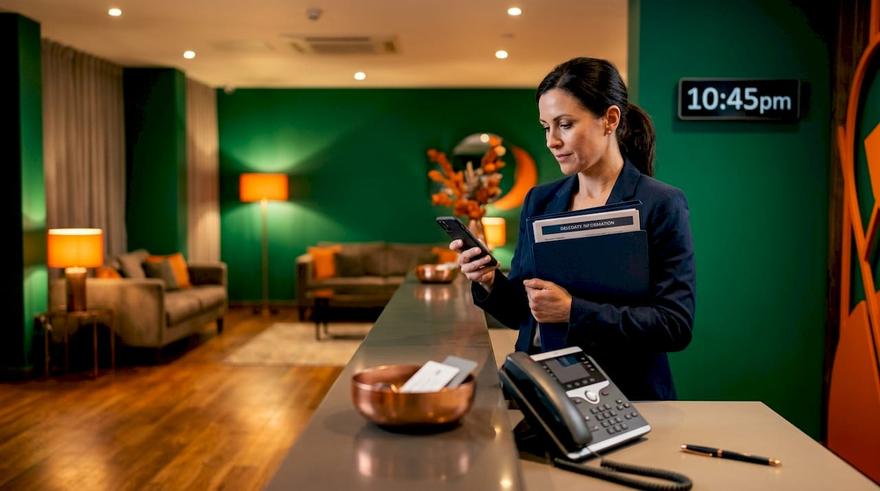
Out of hours housing: a practical guide for corporate events
TL;DR: Managing out-of-hours accommodation for corporate events involves understanding varied property policies, effective communication, and contingency planning. Secure late arrivals by obtaining written access instructions, confirming contact details, and working with trusted property providers to ensure seamless check-ins. Proper preparation reduces risks, costs, and delegate frustration, enabling stress-free event housing management.
TL;DR:
- Managing out-of-hours accommodation for corporate events involves understanding varied property policies, effective communication, and contingency planning. Secure late arrivals by obtaining written access instructions, confirming contact details, and working with trusted property providers to ensure seamless check-ins. Proper preparation reduces risks, costs, and delegate frustration, enabling stress-free event housing management.
Late-night arrivals sound simple until a delegate is standing outside a locked property at midnight, key code in hand, with no one answering the phone. For corporate event planners and travel managers, after-hours accommodation is one of the most overlooked logistics challenges in the entire delegate journey. The assumption that hotels “just handle it” can lead to real disruption, unexpected costs, and frustrated attendees. This guide cuts through the confusion and gives you a clear, actionable framework for managing out-of-hours housing across every type of corporate event, from single-night conferences to multi-day programmes.
Table of Contents
- Understanding out of hours accommodation: what changes after 5pm?
- Common out of hours housing solutions for events and business travel
- Key processes for secure, stress-free after-hours check-in
- Contingency planning: what if late arrivals go wrong?
- Why out-of-hours housing goes wrong: what most guides miss
- Seamless corporate housing: get support for your next event
- Frequently asked questions
Key Takeaways
| Point | Details |
|---|---|
| Know property policies | Accommodation types have different access rules and possible late-arrival fees. |
| Prioritise communication | Advance instructions and clear contacts make after-hours check-in seamless for delegates. |
| Always prepare a backup | A contingency plan is essential for any scenario where late arrivals may be locked out. |
| Match housing to event needs | Choose housing options that best align with delegate convenience and event timing. |
Understanding out of hours accommodation: what changes after 5pm?
After standard business hours, the rules around accommodation access change significantly. Most UK hotels operate staffed front desks between roughly 7am and 11pm, but that window shrinks at smaller properties, independent hotels, and serviced apartments. Once the desk is unstaffed, the responsibility for access shifts to either automated systems or pre-arranged self check-in protocols, and that shift introduces a layer of complexity most travel managers underestimate.
Standard hotel check-in typically begins at 2pm or 3pm, with checkout at 11am or noon. However, check-in policies can differ widely across property types; some set late check-in at 5pm depending on room type, and extra charges may apply for arrivals outside these windows. For serviced apartments and self-catering units, the cut-off can be even earlier, sometimes as restrictive as 4pm, after which a host or manager must be called out specifically to grant access.
Self-catering units present their own complications after 5pm. Unlike a hotel with a physical desk, these properties rely entirely on the host or a key management service. If the host is unresponsive or the key safe code is incorrect, there is no fallback in the building itself. The delegate is simply locked out. This is a meaningful business risk, particularly when attendees have just flown in from Edinburgh or travelled four hours by train from Manchester.
| Property type | Standard check-in | Latest check-in | After-hours access method | Extra charge possible |
|---|---|---|---|---|
| Full-service hotel | 2pm to 3pm | Often 11pm or later | Staffed front desk | Sometimes |
| Budget hotel | 3pm | 10pm to 11pm | Key card or code issued at check-in | Rarely |
| Serviced apartment | 3pm to 5pm | Varies by operator | Key safe or host-managed | Often |
| Self-catering unit | 4pm to 5pm | 8pm to 9pm | Host call-out or key safe | Frequently |
| B&B or guest house | 3pm to 4pm | 9pm to 10pm | Host-dependent | Sometimes |
Policies can vary dramatically even within the same property group. Always confirm the specific procedure for your booking, not just the general brand policy.
Policies can vary dramatically even within the same property group. Always confirm the specific procedure for your booking, not just the general brand policy.
When you are managing a group of twenty delegates arriving at different times across an evening, these policy variations create real logistical risk. A missed check-in window at a self-catering property is not an inconvenience; it is a potential safeguarding issue, a cost spike, and a credibility problem for your organisation. Reviewing corporate housing strategies before finalising accommodation contracts is a strong first step in avoiding these scenarios entirely.
Common out of hours housing solutions for events and business travel
Now that you understand the differences, let us review your primary out-of-hours housing toolkit. There are three main categories planners use regularly, each with distinct advantages and limitations.
1. Hotels with 24-hour front desks
These are the gold standard for late corporate arrivals. A staffed desk means a delegate can arrive at 2am, collect their key, and be guided to their room without any pre-arranged self check-in protocol. Large branded hotels in major UK cities, particularly in London, Birmingham, Manchester, and Edinburgh, typically offer this service as standard. The tradeoff is cost; 24-hour staffed properties command a premium rate, especially during peak conference seasons.
2. Properties with self check-in (key safes or smart locks)
An increasingly popular option, self check-in properties use either a physical key safe with a PIN code or a smart lock that generates a unique digital code per booking. The delegate receives their code by email or SMS in advance and lets themselves in independently. These work well when the instructions are clear and the technology functions correctly. The failure rate is low but not zero, and when it fails at 11pm outside a converted townhouse in Bristol, the consequences are significant.
3. Self-catering apartments with remote or host-managed access
These are common choices for longer stays or groups who need kitchen facilities and more space. The host typically communicates via a messaging platform and either installs a key safe or arranges to meet delegates personally. For events involving temporary staff housing or crew accommodation, this format often makes financial sense, but it requires more coordination.
For events with unusual or unpredictable arrival patterns, including festival event venues and large outdoor gatherings where staff and crew may check in at highly varied times, having a dedicated housing contact is essential.
Key pros and cons at a glance:
- 24-hour hotels: High reliability, high cost, good delegate experience, limited availability in smaller towns
- Self check-in properties: Flexible, cost-effective, dependent on technology working and instructions being followed
- Host-managed apartments: Spacious and economical for longer stays, vulnerable to host availability and communication gaps
For events where arrivals span a wide time range or where you are managing an emergency group housing guide scenario, planning ahead with each option’s failure mode in mind is critical.
Pro Tip: Always obtain written access instructions directly from the property and test the process yourself before distributing to delegates. A code that works on the host’s phone may not work on an older handset in poor signal conditions.
Accommodation operators consistently emphasise that communication and security measures are the highest priority for any off-front-desk check-in, including sending clear arrival instructions in advance and ensuring proper lighting and security at the entrance.
Key processes for secure, stress-free after-hours check-in
Securing an out-of-hours option is only half the battle; the process for guest arrival is equally vital. The most reliable planners do not simply book the right property and hope for the best. They build a repeatable process that works even when individual elements go slightly wrong.
Here is a sequential best-practice approach you can follow for every event:
- Notify the property in advance.Confirm exact estimated arrival times for all delegates at least 48 hours before check-in. For late arrivals, confirm again on the day. Properties need this information to ensure access is prepared and any on-call staff are aware.
- Obtain step-by-step access and security instructions.Do not accept a verbal summary. Request written instructions that include the property address, entry code or key collection point, lift or staircase details, room number, and any security alarm codes. Ask the property to confirm these are current and accurate.
- Communicate clearly to all delegates.Share the instructions by email and as a printable PDF or phone-friendly format. Do not assume delegates will find the confirmation email at 11pm when their battery is at 8%. Consider a dedicated WhatsApp or messaging group for the event.
- Confirm out-of-hours contact details.Every booking should include a direct mobile number for someone who can resolve access issues after the front desk closes. This should be the host, duty manager, or a local property contact, not a call centre that escalates to a non-urgent queue.
- Arrange backup support or alternative housing if needed.Particularly for large events or delegates arriving very late, have a secondary option identified. This might be a nearby hotel with a 24-hour desk or an emergency accommodation contact number.
Notify the property in advance. Confirm exact estimated arrival times for all delegates at least 48 hours before check-in. For late arrivals, confirm again on the day. Properties need this information to ensure access is prepared and any on-call staff are aware.
Obtain step-by-step access and security instructions. Do not accept a verbal summary. Request written instructions that include the property address, entry code or key collection point, lift or staircase details, room number, and any security alarm codes. Ask the property to confirm these are current and accurate.
Communicate clearly to all delegates. Share the instructions by email and as a printable PDF or phone-friendly format. Do not assume delegates will find the confirmation email at 11pm when their battery is at 8%. Consider a dedicated WhatsApp or messaging group for the event.
Confirm out-of-hours contact details. Every booking should include a direct mobile number for someone who can resolve access issues after the front desk closes. This should be the host, duty manager, or a local property contact, not a call centre that escalates to a non-urgent queue.
Arrange backup support or alternative housing if needed. Particularly for large events or delegates arriving very late, have a secondary option identified. This might be a nearby hotel with a 24-hour desk or an emergency accommodation contact number.
Research shows that properties managing after-hours check-in most successfully are those that send detailed arrival instructions proactively and ensure lighting and security are in place before the guest arrives, not after a complaint is raised.
For group events, working with specialists on secure group bookings can ensure these processes are contractually embedded rather than left to informal arrangement with individual properties.
Pro Tip: Create a one-page printable instruction sheet for each delegate that includes the property address, access code, step-by-step entry instructions, a backup contact number, and the nearest 24-hour hotel as a fallback. Laminate it and include it in delegate packs if the event warrants it.
Contingency planning: what if late arrivals go wrong?
Even with robust planning, not every late-night arrival goes smoothly, and here is how you can stay prepared. Planners who have managed large-scale events know that the question is not whether something will go wrong; it is whether they have a response ready when it does.
The most common failure points and recommended responses are as follows:
| Failure point | Likely cause | Recommended response |
|---|---|---|
| Front desk closed early | Miscommunication on arrival time | Call duty manager or on-call number immediately |
| Key safe code invalid | Code changed or entered incorrectly | Contact host directly; request refreshed code |
| Smart lock battery dead | No maintenance check before arrival | Request manual key override from property |
| Host unreachable | Out of area, phone off | Escalate to platform support or emergency housing |
| Delegate arrives after guaranteed booking window | Very late flight or transport delay | Activate pre-identified backup property |
If delegates arrive after the property’s latest check-in window, guarantees and front desk support may lapse entirely. This is when having a backup plan is not a luxury; it is a professional necessity.
Your emergency resource list should include:
- The direct mobile number of the property host or duty manager
- The name and address of the nearest 24-hour hotel with confirmed availability
- A contact at your travel management provider or venue finding service who can handle urgent rebooking
- The corporate credit card or booking authorisation code needed to make an emergency reservation
- The delegate’s own direct phone number so you can coordinate in real time
For planners managing events at large venues, such as a reception or events centre where delegates may be travelling from multiple locations, this contingency list should be distributed to your entire events team, not just held by one person.
Specialist guidance on how to book emergency housing for corporate events quickly is available if you need to work through a worst-case scenario in advance. Reviewing this before your next event could save you a very stressful phone call at midnight.
Why out-of-hours housing goes wrong: what most guides miss
Most advice on after-hours accommodation focuses on technology. Key safes, smart locks, digital codes, automated welcome messages. These tools are genuinely useful, but they create a false sense of security. In our experience working with corporate planners across the UK since 2003, the majority of after-hours failures are not technology failures. They are communication failures.
A code sent to the wrong email address. A PDF attachment that will not open on a mobile device. An instruction sheet that assumes the delegate knows which entrance to use on a property with three doors. A host who has two phones and answers one. These are the real reasons delegates end up stranded. No amount of smart lock technology solves a problem rooted in unclear communication and diffuse responsibility.
The planners who handle after-hours accommodation best do something deceptively simple. They assign a named human contact for every late-arrival scenario, someone who knows the property, the delegate, and the plan. Not an app. Not an automated message. A person with a phone who is awake and prepared to respond.
There is also an overlooked risk in over-relying on delegates themselves to manage access. Corporate travellers are busy, often tired, and frequently distracted. Sending a long email at 4pm on the day of travel and expecting them to extract the access code at 11:30pm is optimistic at best. The planner’s job is to reduce the cognitive load on the delegate, not increase it.
If you want to look at the broader picture of flexible event housing for different types of business need, there are resources that go beyond standard check-in guidance and address the full spectrum of emergency and contingency accommodation in the UK.
The unconventional truth is this: the best after-hours housing plan is the one your delegate never has to think about because it was managed entirely in advance.
Seamless corporate housing: get support for your next event
Managing after-hours housing for a corporate event is genuinely complex, but it does not have to fall entirely on your shoulders. Specialist support can handle property identification, contract negotiation, access coordination, and contingency planning as part of a single managed service. At Jigsaw Conferences, we have been arranging corporate event accommodation through our free venue finding service since 2003, working with hotels, serviced apartments, and specialist housing providers across every major UK city and beyond. Whether you are planning a one-night conference stay or managing accommodation for a week-long programme with delegates arriving at all hours, we can identify the right properties, negotiate the right terms, and ensure late arrivals are handled properly from the outset.
Frequently asked questions
What counts as out of hours for hotel check-in in the UK?
Most hotels define “out of hours” as arrival after the staffed front desk closes, which typically means after 10pm, though some self-managed units may set even earlier cut-offs. Standard check-in is usually 3pm, with some self-catering properties setting restrictions as early as 5pm.
Is there an extra charge for late check-in or out-of-hours accommodation?
Some properties in the UK charge extra for late check-in, especially self-catering apartments, while others include it as a standard feature. Research confirms that some hotels now charge for arrivals outside their standard window, so always confirm this at the time of booking.
How do I ensure safe and easy access for delegates arriving after hours?
Send clear access instructions in advance, confirm the security arrangements, and provide a backup contact number for every delegate. Detailed arrival instructions and proper security, including lighting at entry points, are consistently recommended for all late check-ins.
What is a good backup plan if a delegate cannot access their room after hours?
Have a secondary accommodation option or emergency contact ready before the event, and make sure all delegates know how to reach them. Having a backup property or holding option is strongly advised whenever late arrivals are a realistic possibility.
Jigsaw Conferences Editorial Team
Verified AuthorThe Jigsaw Conferences Editorial Team comprises venue finding experts with over 20 years of combined experience in the events and hospitality industry. Our team includes certified meeting professionals (CMP), venue sourcing specialists, and industry analysts who provide authoritative insights on venue selection, event planning, and corporate accommodation.