
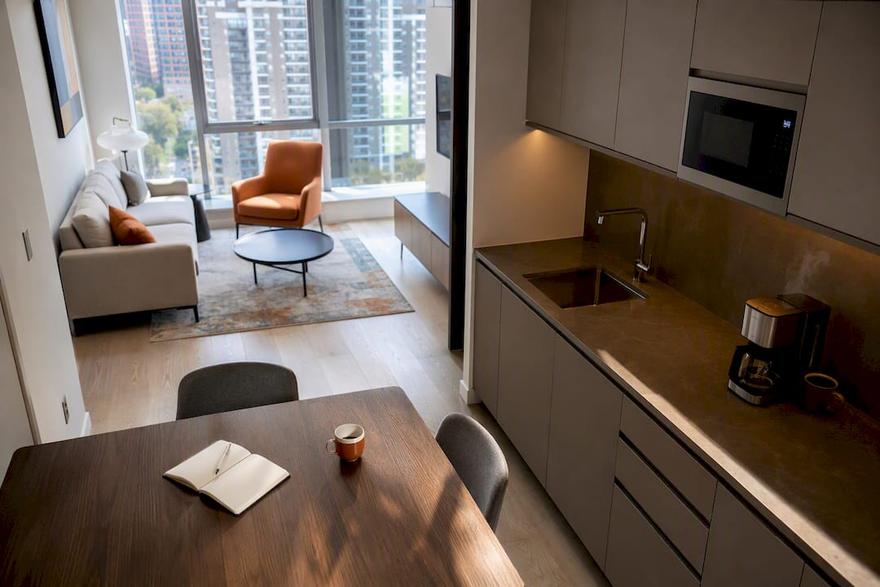
Apartments for corporate travel: a procurement guide
When corporate travel managers say “apartments,” they mean serviced apartments and corporate housing: professionally managed, fully furnished residential units let on flexible terms for business stays. The Corporate Housing Providers Association (CHPA) defines the category as accommodation typically used for stays beyond 30 days, and the Global Serviced Apartment Industry Report (GSAIR) shows demand climbing as hybrid working reshapes business travel. The verdict: choose apartments over hotels for extended trips, relocations, project deployments and multi-night event housing, especially where a traveller’s wellbeing or workspace matters. Jigsaw Conferences sources these units for corporate clients across the UK.
Key Takeaways
Apartments beat hotels on total cost and traveller wellbeing for stays past roughly 30 nights, provided procurement locks down invoicing, reporting and duty-of-care terms upfront.
| Point | Details |
|---|---|
| Use the 30-night threshold | CHPA’s own definition marks 30+ nights as the point apartments typically outperform hotels on cost. |
| Book early where possible | UK lead times are lengthening, with 28% of bookings now made more than 60 days ahead. |
| Compare full cost, not headline rate | Include utilities, cleaning, meals and management fees before judging apartments against hotels. |
| Choose your provider model deliberately | Client-centred sourcing suits multi-city or scaling group bookings better than single-landlord deals. |
| Brief Jigsaw Conferences directly | Jigsaw sources rate cards, manages group check-ins and consolidates invoicing for corporate apartment bookings. |
Table of Contents
- What are the key benefits of apartments for corporate programmes?
- When should you book an apartment instead of a hotel?
- What is included in a serviced apartment booking?
- How do you procure apartments and avoid contract pitfalls?
- How do apartment costs compare with hotels over a longer stay?
- What operational steps matter for group or event accommodation?
- How Jigsaw Conferences supports corporate apartment bookings
- Ready to brief Jigsaw Conferences on your apartment needs?
- Sources
- FAQ
What are the key benefits of apartments for corporate programmes?
The business case comes down to space and structure. A one or two-bedroom apartment gives a travelling employee a separate living and sleeping area, a kitchen and often laundry facilities, which tends to lower the cost per stay against an equivalent hotel booking once nights stretch past a fortnight. GSAIR’s research points to a second, less obvious driver: employees increasingly prefer apartments because they support proper work-life separation during long assignments, not just lower rates.
For procurement, the appeal is administrative as much as financial:
- Consolidated folios instead of daily incidentals across dozens of hotel bills
- Rate cards that lock in pricing for repeat bookings or preferred supplier frameworks
- Simpler expense reconciliation with fewer ad hoc charges to query
- Kitchen facilities that cut per diem meal spend on longer trips
Pro Tip: Ask suppliers to build amenity tiers (basic, standard, premium) into your rate card upfront. It stops last-minute upgrades being billed at rack rate, mid-stay.
When should you book an apartment instead of a hotel?
Length of stay is the clearest signal. CHPA’s own definition draws the line at 30 nights, and that threshold is a sensible working rule for any procurement policy. Below it, hotel loyalty rates or negotiated corporate rates often still win on price and flexibility.
Use apartments for:
- Extended business travel or secondments running six weeks or longer
- Employee relocations, where a family needs a functioning home rather than a room
- Project teams and consultants embedded on-site for a defined engagement
- Event staff and crew needing multi-night housing near a venue
- Blended bleisure trips, where an employee extends a work trip privately
Lead times matter too. In the UK, bookings made more than 60 days ahead rose to 28% of all serviced apartment reservations in the first half of 2025 , a sign that buyers who plan early get better inventory and pricing. Groups and single travellers follow different logic: one person needs a studio or one-bedroom close to the office; a delegate group needs a cluster of units near the venue with staggered check-ins.
What is included in a serviced apartment booking?
Standard inclusions rarely vary much between providers: furniture, kitchenware, linens, utilities, high-speed Wi-Fi and a defined housekeeping schedule, usually weekly for stays over a month. Maintenance response and concierge support are often available as add-ons rather than baked into the base rate.
Where providers differ is in their operating model, and this is where procurement should focus attention:
- Local or unit-centred inventory : individual apartments sourced flat by flat, offering flexibility on location but less consistency in standards
- Apartment-community inventory : whole buildings or blocks of furnished units run by a single operator, giving predictable quality and easier group bookings
- Client-centred sourcing : a broker or agency, such as Jigsaw Conferences, that matches your brief against multiple supplier networks rather than one fixed inventory
Corporate housing sits within a formal UK industry classification , with serviced apartments and aparthotels recognised as its core products. For scalability and cost predictability across multiple cities, a client-centred sourcing model usually beats managing several unit-centred landlords directly.
How do you procure apartments and avoid contract pitfalls?
A workable procurement checklist runs through five stages:
- Define scope: occupancy profile, minimum stay length, number of units and locations
- Request a rate card covering base rent, cleaning frequency and any tiered amenities
- Confirm invoicing structure: one consolidated invoice versus per-unit billing
- Agree reporting requirements: occupancy, extensions, incidents, duty of care
- Check local licensing and insurance cover before signing
Before committing, B2B Travel Media identifies three pillars worth interrogating with any supplier: a genuinely furnished workspace and kitchen, flexible lease terms rather than a rigid fixed period, and a bundled administrative model that keeps invoicing and duty-of-care reporting simple.
Red flags to walk away from:
- Vague or itemised invoicing with no consolidated option
- No corporate references or verifiable track record
- No real-time occupancy or incident reporting
- No named emergency contact outside office hours
Pro Tip: Write scalability into the rate card itself, not just the contract preamble. State the discount or lead time that applies if you need five extra units at 48 hours’ notice.
How do apartment costs compare with hotels over a longer stay?
A fair comparison needs the full cost stack, not just the headline rate: nightly or monthly charge, utilities, cleaning frequency, meals, local transport, VAT and any management fee the supplier adds. Hotels bundle most of this into one rate; apartments often itemise it, which can make them look more expensive until you add everything up properly.
Take a 60-night stay. A mid-range hotel at £140 a night runs to £8,400 before breakfast, parking or laundry. An equivalent one-bedroom apartment at £95 a night, including utilities and weekly cleaning, comes to £5,700, and the traveller’s ability to cook rather than expense every meal typically saves several hundred pounds more. Average corporate housing stays have historically run into months rather than nights , which is exactly the range where this arithmetic favours apartments. For stays under two weeks, or where your hotel rates are already heavily negotiated, a hotel can still be the cheaper and simpler option.
What operational steps matter for group or event accommodation?
Housing a group for a conference or event needs its own checklist, separate from a single traveller’s booking:
- Confirm arrival windows and stagger check-ins to avoid a queue at one front desk
- Issue guest information packs with Wi-Fi codes, access instructions and a local contact number
- Set a cleaning rota that doesn’t clash with delegate schedules during the event
- Agree an on-site or on-call contact for lockouts, maintenance and emergencies
- Book units within a genuine walking or short transfer distance of the venue
Pro Tip: Insist on a single point of contact at the supplier for the whole event, not a different account handler per building. It’s the difference between one phone call and five when someone needs an extra night added mid-conference.
How Jigsaw Conferences supports corporate apartment bookings
Jigsaw Conferences has sourced venues and accommodation for corporate clients since 2003, working across serviced apartments, event housing and emergency B2B placements when plans change at short notice. The team negotiates rate cards directly with apartment operators, manages group check-ins for event housing, and handles the reporting travel managers need for duty-of-care sign-off. A typical conference housing brief might involve 40 delegates needing units within walking distance of a venue for four nights, split across two apartment blocks with staggered arrivals, all invoiced through one consolidated bill.
Ready to brief Jigsaw Conferences on your apartment needs?
There’s no fee for using Jigsaw Conferences to source your accommodation, whether that’s a single relocating employee or forty delegates housed across a city for a week of meetings. The advantage over sourcing apartments directly yourself is straightforward: one brief gets you options across multiple supplier networks, rate cards already negotiated, and a single consolidated invoice instead of chasing five separate landlords for paperwork.
To get moving, send a brief with these minimum details: check-in and check-out dates, number of travellers or delegates, preferred neighbourhoods or proximity to a specific venue, budget range per night or per month, and any special requirements such as accessibility or pet-friendly units. A workable one-paragraph brief reads something like: “We need eight one-bedroom apartments in central Manchester for 45 nights from March 2026, walking distance to venue], budget around £110 per night per unit, consolidated invoicing required.” From there, Jigsaw handles supplier negotiation, duty-of-care checks and reporting, whether you’re arranging [corporate relocation rentals for staff or housing for an entire event team. Get in touch through Jigsaw Conferences to start your brief today.
Sources
- What is Corporate Housing - Corporate Housing Providers Association
- Corporate relocations and bleisure driving growth serviced apartments in the UK
- What a corporate apartment really means for modern business travel programmes
FAQ
What counts as a corporate apartment?
A professionally managed, fully furnished residential unit let on flexible terms for business travel, typically for stays of 30 days or more, according to CHPA.
Are apartments cheaper than hotels for business trips?
Usually yes for stays beyond two to three weeks, once utilities, cleaning and meals are factored in, though very short stays or heavily negotiated hotel rates can still be cheaper.
How far in advance should we book?
Can Jigsaw Conferences arrange apartments for a large event?
Yes, Jigsaw Conferences sources and coordinates multi-unit bookings for delegate groups and event staff, including consolidated invoicing and duty-of-care reporting.
What should we ask a corporate housing supplier before signing?
Ask about cancellation flexibility, invoicing structure, reporting capability, local licensing and whether they can scale up units at short notice.
Jigsaw Conferences Editorial Team
Verified AuthorThe Jigsaw Conferences Editorial Team comprises venue finding experts with over 20 years of combined experience in the events and hospitality industry. Our team includes certified meeting professionals (CMP), venue sourcing specialists, and industry analysts who provide authoritative insights on venue selection, event planning, and corporate accommodation.