
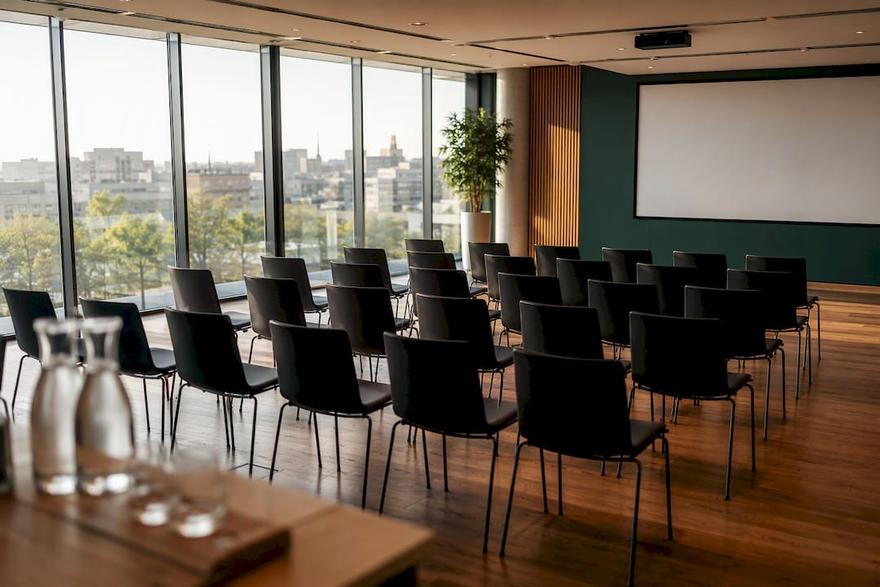
Choosing a wedding venue for corporate events: what to check first
For corporate events, choose the venue that best delivers your event objective, the delegate journey and the fullest package value, not the prettiest room. That single rule should filter out most unsuitable options before you pick up the phone.
Run three checks in under five minutes on any shortlist candidate: can delegates reach it within your target travel time, does the room format actually fit your headcount once staging and registration are added, and does the quoted package include the essentials or hide extras behind a low headline rate. Pendley Manor’s venue checklist frames this well: accessibility, room fit, reliable technology, catering quality and breakout space are the five factors that decide whether a venue actually works, not just whether it looks good in photos.
- Location and access: check drive time, parking, and rail or airport links against your delegate list
- Room fit: confirm layout capacity after AV, staging and registration space are subtracted
- Package inclusions: get a full breakdown before you compare headline day rates
Once those three checks pass, start booking site visits and building a comparison shortlist.
Key Takeaways
Choosing a corporate event venue works best when the event objective, not the room’s appearance, drives every decision from capacity through to contract terms.
| Point | Details |
|---|---|
| Define the objective first | Filter venues against what the event needs to achieve before comparing price or aesthetics. |
| Test real capacity, not nominal | Confirm room layouts with staging, AV and registration space already subtracted. |
| Get full package breakdowns | Ask for line-item pricing on DDR and 24-hour rates to catch hidden extras before signing. |
| Verify technical support in writing | Confirm bandwidth guarantees, AV inclusions and named on-site technical contacts. |
| Visit before you commit | A site visit reveals catering quality, noise, and true proportions that emails cannot. |
Table of Contents
- How to choose a corporate event venue: a screening checklist
- Does the room layout actually suit your event format?
- What technical checks stop hybrid events failing on the day?
- How do you budget and negotiate a corporate venue contract?
- Accommodation and logistics for multi-day corporate events
- How a venue-finding partner like Jigsaw Conferences helps
- Matching venue style to your event’s tone and purpose
- Will the venue provide an on-site coordinator for your event?
- What licences and permits does the venue need?
- Can you customise the venue’s décor for your event?
- What the checklists get right, and what they miss
- Sources
- FAQ
How to choose a corporate event venue: a screening checklist
Before you send a single enquiry, work through this checklist in order. It stops you wasting time on venues that fail basic fit tests, and it gives procurement a consistent way to compare options.
- Map the delegate journey first.Work out realistic travel times from where your attendees are coming from, not from where the venue is. A venue 40 minutes from the nearest station reads fine on a map but adds an hour to a delegate’s day once you account for the walk, ticket queues, and connections. Check parking capacity too. Many venues quote total spaces without noting how many are reserved for staff or other events on the same day.
- Stress-test the capacity numbers.A room advertised as fitting 150 theatre-style rarely holds 150 once you add a stage, a lectern, screens, and a registration desk at the entrance. Ask the venue for capacity figures with AV and staging already factored in, not the nominal maximum.
- Interrogate the delegate package.Confirm exactly what a day delegate rate or 24-hour rate includes. Pendley Manor notes that headline rates often exclude Wi-Fi upgrades, extra breakout rooms, or evening drinks receptions, so ask for a full breakdown rather than a single figure.
- Check catering and dietary provision early.Request a sample menu and confirm how many dietary variations are included at no extra cost. Venues that charge per special dietary meal can add hundreds of pounds to a 100-delegate event.
- Confirm accessibility compliance in your first enquiry.Step-free access, accessible toilets, and induction loops should be standard questions, not afterthoughts raised days before the event.
- Match lead time to event size.A small meeting for under 20 people can often be booked within two to three weeks. A mid-size conference for 50 to 150 delegates typically needs six to eight weeks. A large conference above 200 delegates, especially with exhibition space or multiple breakouts, needs three months or more to secure the right date and negotiate terms properly.
Map the delegate journey first. Work out realistic travel times from where your attendees are coming from, not from where the venue is. A venue 40 minutes from the nearest station reads fine on a map but adds an hour to a delegate’s day once you account for the walk, ticket queues, and connections. Check parking capacity too. Many venues quote total spaces without noting how many are reserved for staff or other events on the same day.
Stress-test the capacity numbers. A room advertised as fitting 150 theatre-style rarely holds 150 once you add a stage, a lectern, screens, and a registration desk at the entrance. Ask the venue for capacity figures with AV and staging already factored in, not the nominal maximum.
Interrogate the delegate package. Confirm exactly what a day delegate rate or 24-hour rate includes. Pendley Manor notes that headline rates often exclude Wi-Fi upgrades, extra breakout rooms, or evening drinks receptions, so ask for a full breakdown rather than a single figure.
Check catering and dietary provision early. Request a sample menu and confirm how many dietary variations are included at no extra cost. Venues that charge per special dietary meal can add hundreds of pounds to a 100-delegate event.
Confirm accessibility compliance in your first enquiry. Step-free access, accessible toilets, and induction loops should be standard questions, not afterthoughts raised days before the event.
Match lead time to event size. A small meeting for under 20 people can often be booked within two to three weeks. A mid-size conference for 50 to 150 delegates typically needs six to eight weeks. A large conference above 200 delegates, especially with exhibition space or multiple breakouts, needs three months or more to secure the right date and negotiate terms properly.
Pro Tip: Ask every shortlisted venue for the same three numbers, room capacity with staging included, total package cost per delegate, and cancellation deadline, in the same format. It turns a vague comparison into a clean spreadsheet.
Does the room layout actually suit your event format?
The right room format depends entirely on what the event needs to achieve, not what looks impressive. Theatre-style suits large presentations with minimal interaction. Cabaret works better for workshops where delegates need table space and eye contact with each other. Boardroom format suits small strategic sessions of under 20 people where discussion matters more than presentation.
Sightlines matter more than most planners expect. A pillar in the wrong place or a low ceiling that forces screens down to head height can ruin a presentation for half the room. Natural light and ventilation also affect how alert delegates feel by mid-afternoon. Pendley Manor highlights daylight and breakout space as factors that reduce fatigue over a full-day event, and that matters more on a six-hour conference day than a one-hour meeting.
Registration flow and refreshment breaks need their own space, separate from the main room, so delegates aren’t queuing for coffee while a session is trying to start on time. Networking space, even a corridor with high tables, gives delegates somewhere to talk between sessions without blocking doorways.
Before booking, verify these claims in person:
- Stand where your presenter will stand and check the sightline to the back row
- Walk the route from entrance to registration to main room and time it
- Check ceiling height against your screen and rigging requirements
- Confirm breakout rooms are genuinely separate, not a curtain across one large space
Flavour Search’s venue guide makes the same point: advertised capacities often change once AV, staging and registration are actually in place, so a floor plan on paper is not proof of a working layout.
What technical checks stop hybrid events failing on the day?
Hybrid and livestreamed events fail for predictable reasons: weak Wi-Fi, unclear AV inclusions, and no one on site who can fix a problem quickly. Ask for a written bandwidth guarantee per room, not a building-wide average, since a shared connection across five meeting rooms can collapse the moment two of them start streaming simultaneously.
Clarify what’s included in the AV package versus what’s billed as an extra. Basic screens and microphones are usually included; multi-camera streaming setups, additional confidence monitors, and technical operators are frequently charged separately.
- Request a written minimum bandwidth figure for your specific room, not the whole venue
- Get a full list of AV items included in the package versus billed as extras
- Ask specifically who resolves a technical fault mid-event, venue staff or an external contractor
- Confirm a backup internet connection exists and how quickly it can be switched over
Flavour Search recommends confirming on-site technical support and who is responsible for fixing issues on the day. Get a named contact and a response-time commitment in writing, not a verbal assurance during the site visit.
Pro Tip: Ask for the AV supplier’s escalation number before the event, not on the day. If the venue can’t produce one quickly, that’s a warning sign about how prepared they are for problems generally.
How do you budget and negotiate a corporate venue contract?
Comparing day delegate rates against 24-hour packages only works if you strip both down to the same components: room hire, catering, AV, and accommodation where relevant. A DDR that looks cheaper per head can lose its advantage once you add evening accommodation separately, while a 24-hour rate that looks expensive upfront might already include everything.
- Request full line-item breakdowns, not headline per-delegate figures. Ask specifically what’s excluded: Wi-Fi upgrades, extra breakout space, evening drinks, and equipment hire are the usual culprits that inflate a final invoice.
- Price for your maximum likely numbers, plus a buffer.Pendley Manor’s guidance suggests requesting per-item pricing for your largest anticipated guest count and for a 10% uplift on top, so a late surge in bookings doesn’t force a re-costing exercise days before the event.
- Read the cancellation clause before you sign anything.Confirm the deadline, the sliding scale of charges, and whether force majeure is defined broadly enough to cover genuine disruption, not narrowly enough to exclude almost everything.
- Check minimum number clauses and indemnity terms.Some contracts commit you to paying for a minimum headcount regardless of final attendance, which matters if your numbers are still firming up.
- Negotiate on flexible dates first.Venues discount harder for midweek, off-peak, or last-minute availability than they do on catering upgrades.
Request full line-item breakdowns , not headline per-delegate figures. Ask specifically what’s excluded: Wi-Fi upgrades, extra breakout space, evening drinks, and equipment hire are the usual culprits that inflate a final invoice.
Price for your maximum likely numbers, plus a buffer. Pendley Manor’s guidance suggests requesting per-item pricing for your largest anticipated guest count and for a 10% uplift on top, so a late surge in bookings doesn’t force a re-costing exercise days before the event.
Read the cancellation clause before you sign anything. Confirm the deadline, the sliding scale of charges, and whether force majeure is defined broadly enough to cover genuine disruption, not narrowly enough to exclude almost everything.
Check minimum number clauses and indemnity terms. Some contracts commit you to paying for a minimum headcount regardless of final attendance, which matters if your numbers are still firming up.
Negotiate on flexible dates first. Venues discount harder for midweek, off-peak, or last-minute availability than they do on catering upgrades.
Accommodation and logistics for multi-day corporate events
On-site accommodation earns its cost when delegates are travelling internationally, when the agenda runs into the evening, or when early starts make a commute impractical. For a single-day local meeting, a nearby hotel block usually covers the need without the premium of an all-in-one venue.
Corporate housing and serviced apartments suit longer stays or delegations that need self-catering flexibility, while emergency B2B housing matters more than most planners budget for. Flight delays, visa issues, or a last-minute change of delegate numbers can leave you needing rooms within hours, not days.
For international delegates, transfer coordination between airport, hotel, and venue needs its own line in the plan. A shared coach for a large group is usually cheaper and less stressful to manage than individual taxi bookings scattered across arrival times.
- Book a hotel block early and confirm the release date for unsold rooms
- Coordinate production, catering, and transport suppliers against one master timeline
- Keep a contingency contact for emergency accommodation changes
- Ask corporate housing providers about last-minute availability policies
How a venue-finding partner like Jigsaw Conferences helps
Jigsaw Conferences has sourced venues and corporate accommodation for events since 2003, running a free venue search, corporate housing sourcing, and emergency B2B housing for clients who need rooms fast. The value shows up in three places: time saved on enquiries, clearer contract terms negotiated through existing supplier relationships, and one point of contact coordinating venue, accommodation, and logistics instead of five separate email threads.
An agency earns its place fastest under pressure, tight lead times, complex multi-city accommodation needs, or events spread across several venues in one week.
A venue-finder can improve value by negotiating included services and identifying reliable suppliers, cutting the procurement time a busy events team spends chasing quotes.
A venue-finder can improve value by negotiating included services and identifying reliable suppliers, cutting the procurement time a busy events team spends chasing quotes.
Starting a brief is straightforward: outline your event objective, delegate numbers, dates, and budget range, and expect a shortlist with package comparisons rather than a single recommendation pushed at you.
Matching venue style to your event’s tone and purpose
Style choices for a corporate event should follow the same logic as room format: they support the objective, not just the aesthetic. A product launch benefits from a striking, contemporary space with strong branding opportunities. A board strategy session usually works better in a understated, quiet setting where the room itself doesn’t compete for attention.
Mismatched style creates a subtler problem than most planners expect. A heritage venue with ornate décor can undercut a message about innovation, while a stark, glass-walled space can feel cold for an event meant to build team relationships. Ask venues what other events they typically host. A room built primarily for celebrations or formal dinners often has fixed lighting and layout constraints that fight against a working conference agenda.
Branding flexibility matters here too. Confirm whether the venue allows your own signage, banners, and screen branding, or whether house rules restrict what can go on the walls. Some venues charge separately for removing existing artwork or furniture to make space for your setup.
If your event runs across multiple sessions with different tones, a stage keynote followed by informal networking, check whether the venue has distinct spaces for each rather than forcing both into one room with a quick furniture change. A flexible event space that can be reconfigured between formats often solves this better than a single grand room trying to do everything.
Will the venue provide an on-site coordinator for your event?
An on-site coordinator changes how smoothly an event runs, often more than any other single factor. Ask directly whether one person is assigned to your event for the full day, or whether you’re sharing a duty manager across several bookings happening simultaneously in the same building.
A dedicated coordinator handles the details that derail an agenda when no one owns them: chasing a late catering delivery, resolving a room temperature complaint, or redirecting delegates when registration queues build up. Ask what happens if that coordinator is unavailable, is there a named deputy, or does responsibility fall back to general venue staff who don’t know your event’s specifics.
For events with external suppliers, production, AV, entertainment, confirm whether the venue coordinator liaises directly with them on the day or whether that responsibility sits entirely with your own team. Larger conferences benefit from a coordinator who has run a similar format before rather than one learning the venue’s own systems for the first time alongside your event.
Pro Tip: Ask to meet the actual coordinator assigned to your date during the site visit, not a sales contact who won’t be there on the day. Their familiarity with the room and their communication style matter more than the brochure.
What licences and permits does the venue need?
Licensing requirements depend heavily on what the event actually involves, not just where it’s held. A standard daytime conference with no alcohol service typically needs nothing beyond the venue’s own operating licence. Add an evening drinks reception, and the venue needs a premises licence covering alcohol sales, which most established conference venues already hold, but always confirm it rather than assume.
Live music, amplified sound after certain hours, or outdoor elements can trigger additional local authority permissions depending on the venue’s location and its existing licence conditions. Ask the venue directly which of these apply and who is responsible for securing them, the venue or your organisation.
Fire safety certification and maximum occupancy limits are enforced through the venue’s own licence, and this is exactly why nominal capacity claims need checking against what the licence actually permits once staging, catering stations, and extra furniture are added. A room licensed for 200 under normal conditions may be capped lower once event-specific setup reduces usable floor space.
For any event involving external caterers rather than in-house catering, confirm whether the venue requires proof of the caterer’s own food hygiene certification and public liability insurance before granting access. This is a common oversight that surfaces only days before the event if it isn’t checked early.
Can you customise the venue’s décor for your event?
Décor flexibility varies enormously between venue types, and it’s worth confirming before you commit budget to branding, staging, or bespoke furniture. Some venues allow full reconfiguration, moveable walls, freestanding signage, custom lighting rigs, while others operate under strict house rules that protect period features, fixed artwork, or listed-building conditions.
Ask specifically about wall-mounting restrictions, floor coverings, and whether adhesive signage is permitted at all. Venues in historic or listed buildings often prohibit anything that could mark walls or ceilings, which rules out certain banner and rigging setups outright.
Confirm what happens to existing furniture and décor during your event. Some venues remove house furnishings for a fee, while others charge a bond against potential damage if you bring your own staging or branding elements. Clarify this cost before it appears as a surprise line item on the final invoice.
If your event needs specific lighting, colour washes, branded gobos, or a particular stage backdrop, check whether the venue’s electrical supply and rigging points can support your supplier’s equipment. A room that looks flexible on a walkthrough can have surprisingly limited power outlets or load-bearing points once a production supplier assesses it properly. Building this check into your venue comparison checklist early avoids a late scramble to find an alternative supplier or venue.
What the checklists get right, and what they miss
Most venue guides treat every check as equally important, which is exactly where they fail busy procurement teams. Location, capacity, catering, and technology aren’t equal weights on a scale. Get the delegate journey wrong and nothing else recovers it, a brilliant AV setup means nothing if half your attendees arrive 40 minutes late and rattled.
The conventional advice also underrates contract terms relative to how much attention it gives room aesthetics. Planners spend hours debating décor and thirty seconds reading the cancellation clause, then discover months later that a minimum numbers commitment locked them into a cost they never actually confirmed.
If you take one thing from this article, prioritise the site visit over every brochure claim. Numbers on a spec sheet describe a room; only standing in it tells you whether the sightlines work, whether the Wi-Fi actually holds, and whether the coordinator assigned to your date knows what they’re doing. Everything else, budget comparisons, package inclusions, contract clauses, is easier to get right once that one visit confirms the venue is fundamentally fit for purpose.
— Jigsaw
— Jigsaw
Sources
FAQ
How far in advance should we book a corporate venue?
Small meetings under 20 people can often be booked two to three weeks out; mid-size conferences of 50 to 150 delegates need six to eight weeks; large conferences above 200 people should be secured three months or more ahead.
What’s the difference between a DDR and a 24-hour rate?
A day delegate rate typically covers room hire, standard AV, and daytime catering, while a 24-hour rate adds overnight accommodation and evening meals, so compare both after stripping out what each headline figure actually excludes.
How do we check if a venue’s Wi-Fi will support a hybrid event?
Ask for a written minimum bandwidth guarantee specific to your room, not a building-wide average, and confirm whether a backup connection exists in case the primary link fails during the event.
Should we always insist on a site visit before booking?
Yes for any event above a small meeting. A site visit reveals room proportions, catering quality, and noise levels that quotes and photos routinely misrepresent.
When does it make sense to use a venue-finding service?
Use one when lead times are tight, accommodation needs span multiple cities, or the event spans several venues in one week, since a finder like Jigsaw Conferences can negotiate included services and cut the time your team spends chasing quotes.
Jigsaw Conferences Editorial Team
Verified AuthorThe Jigsaw Conferences Editorial Team comprises venue finding experts with over 20 years of combined experience in the events and hospitality industry. Our team includes certified meeting professionals (CMP), venue sourcing specialists, and industry analysts who provide authoritative insights on venue selection, event planning, and corporate accommodation.