
What Is Emergency Accommodation Like for Events?
Severe weather, transport strikes, or sudden venue closures can throw even the most polished british corporate event into chaos. When plans unravel without warning, finding the right emergency accommodation becomes a race against the clock. With over 60 percent of United Kingdom businesses admitting to last-minute event disruptions , reliable contingency housing is now a vital piece of any event planner’s toolkit. This guide shows how british organisations can secure swift, cost-effective solutions that keep events on track no matter what unfolds.
Table of Contents
- Defining Emergency Accommodation For Events
- Types Of Emergency Accommodation Solutions
- Key Features And Quality Standards
- Booking Process And Response Times
- Legal, Safety, And Compliance Duties
- Costs, Billing, And Negotiation Strategies
Key Takeaways
| Point | Details |
|---|---|
| Rapid Deployment | Emergency accommodation must be able to be mobilised quickly to ensure participant safety and event continuity during disruptions. |
| Quality Standards | Organisations should adhere to quality standards that ensure safety and comfort across all emergency housing solutions. |
| Legal Compliance | It is crucial to navigate legal responsibilities comprehensively, including participant protection and operational compliance during emergency situations. |
| Cost Management | Developing strategic pricing negotiation techniques and partnerships can help manage costs effectively in emergency accommodation scenarios. |
Defining Emergency Accommodation for Events
Emergency accommodation represents a critical short-term housing solution designed to support organisations and attendees during unexpected event disruptions. Unlike traditional lodging, emergency accommodation provides rapid, flexible shelter when standard arrangements fail or unforeseen circumstances emerge.
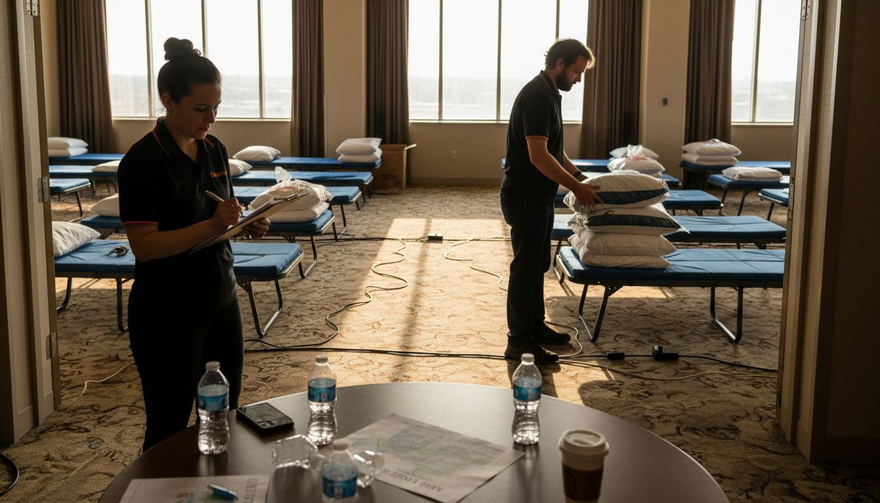
In the context of corporate events, emergency accommodation encompasses temporary housing options that can be quickly mobilised to address sudden logistical challenges. These accommodations range from spare conference rooms and nearby hotel blocks to pre-arranged contingency spaces that can rapidly house displaced delegates or event staff. Corporate venue contingency planning becomes essential in managing these potential disruptions.
The primary objectives of emergency event accommodation include ensuring participant safety, minimising operational interruptions, and maintaining event continuity. Key characteristics typically involve:
- Rapid deployment capabilities
- Flexible capacity scaling
- Proximity to original event venue
- Basic amenities and comfort provisions
- Quick communication and coordination systems
Unlike traditional disaster relief housing, corporate emergency accommodation focuses on short-term professional solutions that enable immediate event recovery and participant support. The goal is not prolonged habitation but swift, efficient temporary shelter that allows events to proceed with minimal disruption.
Expert Tip Always maintain a pre-vetted list of backup accommodation venues within a 15-mile radius of your primary event location to expedite emergency housing arrangements.
Types of Emergency Accommodation Solutions
Emergency accommodation solutions for events encompass a diverse range of temporary housing strategies designed to address unexpected disruptions and logistical challenges. These solutions are carefully crafted to provide immediate shelter and support for event participants, ensuring operational continuity and participant welfare.
Business travel accommodation presents multiple emergency housing approaches that organisations can leverage during critical situations. The most prevalent types include:
- Conference Room Conversions : Transforming existing event spaces into temporary sleeping areas
- Hotel Block Reservations : Pre-arranged backup accommodation in nearby hotels
- Portable Accommodation Units : Modular, rapidly deployable temporary housing solutions
- Corporate Dormitory Spaces : Dedicated emergency housing within corporate facilities
- Partner Venue Arrangements : Collaborative housing solutions with nearby event venues
The selection of emergency accommodation depends on several critical factors, including event scale, location, participant demographics, and specific logistical constraints. Urban settings typically offer more flexible solutions compared to rural environments, with greater accessibility to alternative housing options.
Unlike traditional disaster relief housing, corporate emergency accommodation focuses on professional, short-term solutions that prioritise comfort, accessibility, and swift deployment. The primary objective remains maintaining event momentum while ensuring participant safety and minimal operational disruption.
The table below summarises key emergency accommodation solutions and their ideal use scenarios:
| Solution Type | Best Applied When | Strengths |
|---|---|---|
| Conference Room Conversion | Venue closures or over-capacity | Quickest onsite option |
| Hotel Block Reservations | Large delegate numbers | Comfort and privacy assured |
| Portable Accommodation Units | No nearby hotels | Set up anywhere needed |
| Corporate Dormitory Spaces | Staff relocation requirements | Internal resource efficiency |
| Partner Venue Arrangements | Multiple event disruptions | Shared operational resilience |
Expert Tip Develop a comprehensive emergency accommodation matrix that categorises potential housing solutions by response time, capacity, and cost to streamline decision-making during unexpected events.
Key Features and Quality Standards
Quality standards for emergency accommodation are critical in ensuring participant safety, comfort, and operational efficiency during unexpected event disruptions. These standards encompass a comprehensive framework of physical, operational, and psychological requirements that organisations must carefully consider when implementing temporary housing solutions.
The core quality standards for emergency event accommodation can be categorised into several essential dimensions. Small business travel solutions highlight the importance of a structured approach to emergency housing that addresses multiple critical aspects:
- Physical Infrastructure Minimum space per occupantAdequate ventilation and temperature controlStructural integrity and safetyAccessibility features
- Basic Amenity Requirements Clean bedding and sleeping arrangementsHygiene facilitiesBasic electrical and communication infrastructurePrivacy considerations
- Operational Protocols Rapid deployment capabilitiesClear communication systemsSafety and emergency response mechanismsFlexible scaling options
Physical Infrastructure
- Minimum space per occupant
- Adequate ventilation and temperature control
- Structural integrity and safety
- Accessibility features
Basic Amenity Requirements
- Clean bedding and sleeping arrangements
- Hygiene facilities
- Basic electrical and communication infrastructure
- Privacy considerations
Operational Protocols
- Rapid deployment capabilities
- Clear communication systems
- Safety and emergency response mechanisms
- Flexible scaling options
Unlike traditional accommodation models, emergency event housing demands a dynamic approach that balances immediate practical needs with participant psychological comfort. The standards must be adaptable to diverse event scenarios, from corporate conferences to large-scale professional gatherings, ensuring consistent quality across different contexts.
Professional organisations increasingly recognise that emergency accommodation is not merely about providing a basic shelter, but creating a supportive environment that minimises disruption and maintains participant productivity and wellbeing during unexpected circumstances.
Expert Tip Conduct periodic audit checks of your emergency accommodation protocols, simulating unexpected scenarios to identify and address potential systemic vulnerabilities.
Booking Process and Response Times
The booking process for emergency accommodation represents a critical operational capability that demands precision, speed, and strategic planning. Organisations must develop robust systems that enable rapid response and seamless accommodation allocation during unexpected event disruptions.
Corporate venue finding requires a structured approach to emergency housing bookings, typically involving multiple strategic stages:
- Initial Trigger Assessment Identify accommodation needDetermine participant countEvaluate urgency level
- Preliminary Booking Protocol Contact pre-vetted emergency accommodation partnersVerify immediate availabilityConfirm pricing and capacity
- Rapid Confirmation Process Execute provisional bookingSend participant allocation detailsEstablish communication channels
Initial Trigger Assessment
- Identify accommodation need
- Determine participant count
- Evaluate urgency level
Preliminary Booking Protocol
- Contact pre-vetted emergency accommodation partners
- Verify immediate availability
- Confirm pricing and capacity
Rapid Confirmation Process
- Execute provisional booking
- Send participant allocation details
- Establish communication channels
Response times are paramount in emergency accommodation scenarios, with professional organisations typically aiming to secure alternative housing within 30-90 minutes of initial identification. Urban environments offer more flexibility, with multiple options readily available, while rural settings may require more complex logistical coordination.
The most effective emergency accommodation booking strategies integrate technological solutions, pre-existing partnership networks, and flexible contractual arrangements that enable swift decision-making and minimal operational disruption.
Expert Tip Develop a digital emergency accommodation booking playbook with predefined response protocols and contact hierarchies to reduce decision-making complexity during critical moments.
Legal, Safety, and Compliance Duties
Emergency accommodation for events involves a complex network of legal responsibilities and safety obligations that organisations must meticulously navigate to protect participants, staff, and organisational interests. These duties extend far beyond simple housing provisions, encompassing comprehensive risk management and statutory compliance frameworks.
Banquet hall insurance highlights the critical legal dimensions organisations must consider when implementing emergency accommodation solutions. The primary legal and safety responsibilities include:
- Participant Protection Obligations Ensuring individual safety and privacyMaintaining appropriate physical securityProtecting personal data and informationPreventing potential discrimination
- Operational Compliance Requirements Meeting health and safety regulationsMaintaining appropriate insurance coverageDocumenting emergency response protocolsConducting risk assessments
- Duty of Care Considerations Providing adequate medical supportEstablishing clear communication channelsImplementing emergency evacuation proceduresManaging potential accessibility requirements
Participant Protection Obligations
- Ensuring individual safety and privacy
- Maintaining appropriate physical security
- Protecting personal data and information
- Preventing potential discrimination
Operational Compliance Requirements
- Meeting health and safety regulations
- Maintaining appropriate insurance coverage
- Documenting emergency response protocols
- Conducting risk assessments
Duty of Care Considerations
- Providing adequate medical support
- Establishing clear communication channels
- Implementing emergency evacuation procedures
- Managing potential accessibility requirements
Legal frameworks surrounding emergency accommodation demand proactive risk management, with organisations required to demonstrate reasonable anticipation and mitigation of potential challenges. Professional event managers must develop comprehensive strategies that balance legal compliance with practical operational requirements.
Unlike standard accommodation scenarios, emergency housing situations introduce heightened legal scrutiny, requiring organisations to maintain rigorous documentation, transparent communication, and systematic approach to participant welfare and safety.
Expert Tip Develop a comprehensive legal compliance checklist specific to emergency accommodation that can be rapidly deployed during unexpected event disruptions.
Costs, Billing, and Negotiation Strategies
Emergency accommodation pricing represents a complex financial landscape where strategic negotiation and cost management become critical components of effective event planning. Organisations must develop sophisticated approaches to secure optimal pricing while maintaining high-quality emergency housing solutions during unexpected disruptions.
Small business travel solutions underscore the importance of strategic financial planning in emergency accommodation procurement. The key cost management and negotiation strategies include:
- Pricing Negotiation Techniques Pre-establishing bulk booking ratesNegotiating flexible cancellation termsSecuring volume-based discountsDeveloping multi-event partnership agreements
- Cost Containment Approaches Leveraging existing corporate partnershipsImplementing tiered accommodation optionsUtilizing advanced booking strategiesExploring alternative accommodation sources
- Billing Complexity Management Centralised expense trackingTransparent cost allocation mechanismsRapid reconciliation processesDetailed documentation for financial reporting
Pricing Negotiation Techniques
- Pre-establishing bulk booking rates
- Negotiating flexible cancellation terms
- Securing volume-based discounts
- Developing multi-event partnership agreements
Cost Containment Approaches
- Leveraging existing corporate partnerships
- Implementing tiered accommodation options
- Utilizing advanced booking strategies
- Exploring alternative accommodation sources
Billing Complexity Management
- Centralised expense tracking
- Transparent cost allocation mechanisms
- Rapid reconciliation processes
- Detailed documentation for financial reporting
Urban environments typically offer more competitive pricing and negotiation opportunities compared to rural locations, with greater venue density enabling more flexible pricing structures. Professional event managers must balance cost considerations with quality and reliability to ensure participant satisfaction and operational continuity.
The following table outlines major cost drivers and strategies for emergency accommodation bookings:
| Cost Driver | Urban Environment Impact | Rural Environment Impact |
|---|---|---|
| Venue Availability | Many options, competitive rates | Limited options, higher prices |
| Response Speed | Faster, more flexible options | Longer lead times common |
| Negotiation Leverage | Higher due to market density | Lower, less provider choice |
| Partnership Potential | Frequent, enhances discounts | Scarcer, fewer venues nearby |
Successful emergency accommodation financial strategies integrate proactive planning, strategic partnerships, and flexible contractual arrangements that provide organisations with maximum adaptability during unexpected event scenarios.
Expert Tip Develop a standardised emergency accommodation cost matrix that predetermines pricing thresholds and negotiation parameters to expedite decision-making during critical moments.
Seamless Emergency Accommodation Solutions Tailored for Your Event Needs
Unplanned disruptions during corporate events demand swift and reliable emergency accommodation options that prioritise participant safety and operational continuity. If rapid deployment, flexible capacity, and proximity to your main event venue are key concerns mentioned in the article, Jigsaw Conferences understands these exact challenges. With expert knowledge in event accommodation and corporate housing, we offer comprehensive venue finding and booking assistance designed to ease the pressure when emergencies arise.
Avoid costly delays and last-minute stress by leveraging our extensive network and negotiation power. Whether you require quick hotel block reservations or adaptable partner venue arrangements, our personalised service guarantees time-saving solutions at competitive rates. Explore how our venue sourcing and event management expertise can secure your peace of mind. Act now by visiting Jigsaw Conferences to connect with seasoned professionals who make emergency accommodation a seamless part of your event strategy.
Frequently Asked Questions
What is emergency accommodation for events?
Emergency accommodation refers to short-term housing solutions designed to support organisations and attendees during unforeseen disruptions at events, ensuring safety and continuity.
What types of emergency accommodation solutions are available for events?
Common solutions include conference room conversions, hotel block reservations, portable accommodation units, corporate dormitory spaces, and partner venue arrangements, depending on the specific logistical needs of the event.
What key features should emergency accommodation have?
Emergency accommodation should ensure rapid deployment, flexible capacity, proximity to the original venue, basic amenities, and efficient communication systems to support event continuity and participant comfort.
How quickly can emergency accommodation be booked during an event disruption?
Response times can range from 30 to 90 minutes, with deeper flexibility available in urban environments, allowing for faster booking and confirmation of alternative housing solutions.
Jigsaw Conferences Editorial Team
Verified AuthorThe Jigsaw Conferences Editorial Team comprises venue finding experts with over 20 years of combined experience in the events and hospitality industry. Our team includes certified meeting professionals (CMP), venue sourcing specialists, and industry analysts who provide authoritative insights on venue selection, event planning, and corporate accommodation.