
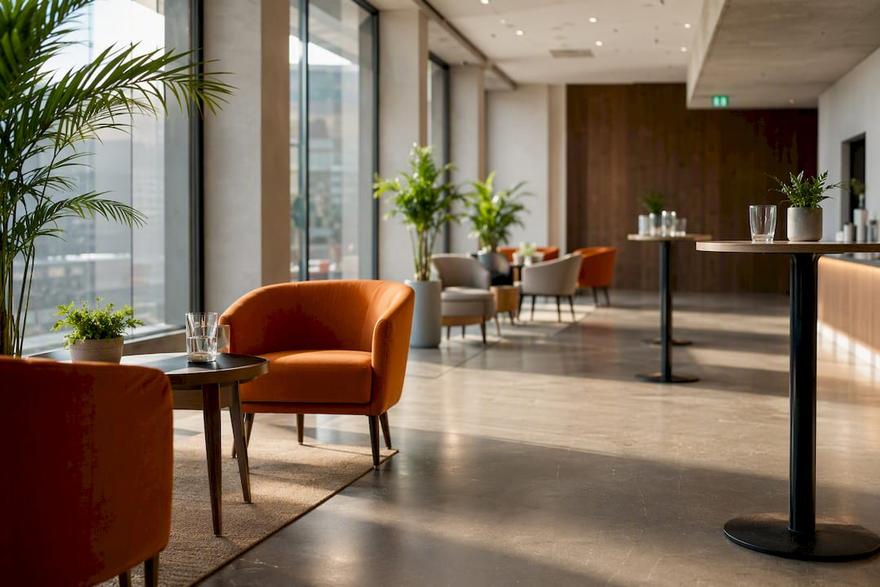
Choosing networking event spaces that actually work
The venue determines whether your networking event succeeds long before the first drink is poured. Three factors predict outcomes more reliably than anything else: a layout that pushes people to move and mingle rather than sit still, AV and connectivity that never drop out mid-pitch, and transport links that don’t cost you a third of your invite list. Shortlist three venues, book viewings, and test the AV yourself while you’re there — that single step catches most of the problems that ruin an otherwise well-planned event.
- Layout — open circulation beats fixed theatre seating for encouraging conversation
- Technical reliability — test Wi-Fi and AV live during your viewing, not on the phone
- Accessibility — check transport links and step-free access before you fall in love with the room
- Tools worth using — platforms like Eventbrite help manage registration once the venue is locked in, and services such as Jigsaw Conferences can run the shortlist and negotiation for you
Key Takeaways
Networking event success depends on layout that encourages movement, AV that works under load, and accessible transport links, tested in person before booking.
| Point | Details |
|---|---|
| Shortlist and view | Narrow to three venues and book site visits before committing to any single option. |
| Test systems live | Check AV and Wi-Fi at expected capacity during the viewing, not from a brochure. |
| Book early for scale | Large events need 12 to 18 months’ lead time; smaller ones can work within 6 months. |
| Budget with contingency | Include venue, catering, AV, staffing, and a 10 to 15% contingency line. |
| Use a venue-finding partner | Jigsaw Conferences shortlists venues, negotiates rates, and coordinates AV and catering for corporate planners. |
Table of Contents
- Why the right networking event space matters more than the guest list
- What makes a good venue for networking events
- Which type of venue suits your networking event?
- What questions should you ask when viewing a venue?
- How do you design a layout that gets people talking?
- When should you book, and what will it cost?
- How does a venue-finding service reduce risk and save time?
- Why most venue checklists miss the point
- Let Jigsawconferences run your venue search
- Sources
- FAQ
Why the right networking event space matters more than the guest list
A venue shapes who talks to whom. Atmosphere, sightlines, and circulation govern serendipity far more than the seniority of your invitees. Put the same 80 people in a cramped meeting room with rows of chairs and a bright open gallery with standing tables, and you’ll get two entirely different events.
Three things go wrong when the venue is wrong: fewer genuine connections get made because people cluster near the door and never move; first impressions suffer because a tired conference room signals a tired brand; and operational hiccups (a dead microphone, a catering delay) eat into the window guests actually have to talk. Venue choice directly shapes accessibility, lighting, and acoustics, and Seven Events’ research on high-impact networking treats these as critical rather than cosmetic.
- Connections formed drop sharply in rooms with poor circulation
- Branding and first impressions are set within minutes of arrival
- Operational reliability (timing, catering, AV) determines whether guests relax enough to network at all
Pro Tip: Walk the room during a quiet moment and look for pinch points, doorways, buffet queues, coat racks, where guests will bunch up and get stuck making small talk with whoever’s nearest, rather than moving on to someone new.
What makes a good venue for networking events
Run through this checklist on every shortlisted venue, then apply a simple rule: accept if it meets the standard outright, negotiate if it’s close, reject if it fails on more than one point.
- Location and transport — within easy reach of major stations or with accessible parking; reject if guests need two changes to arrive on time
- Capacity and flexible configuration — room to switch between standing and seated without a full reset; negotiate on furniture hire if the base layout is fixed
- Circulation and breakout zones — clear paths and at least one separate area for quieter conversation
- Sightlines and acoustics — no pillars blocking key areas, and background noise that won’t drown out conversation
- AV and connectivity — reliable Wi-Fi and tested screens or microphones, non-negotiable for any hybrid element
- Catering capability and service — in-house or approved external caterers who can handle your headcount without queues forming
- Accessibility — step-free access, hearing loops, and accessible toilets as standard, not an afterthought
- Safety and comfort — adequate ventilation, enough toilets for capacity, and clear emergency egress
Weight AV, accessibility, and circulation highest. A stunning room with patchy Wi-Fi or no lift access isn’t a compromise, it’s a different event to the one you promised your invitees. Flexible layouts and freedom of movement consistently support better networking outcomes than fixed seating plans, according to Seven Events’ UK corporate event guide.
Which type of venue suits your networking event?
Different formats call for genuinely different spaces, and matching the two is where most planners either save money or waste it.
- Hotels and conference centres — best for 50 to 500 guests; strong AV and in-house catering, but can feel corporate and interchangeable; negotiate on room hire when you book catering through them too
- Private members’ clubs — suit smaller, senior audiences (20 to 80); strong image and service, higher cost, and often stricter guest-list rules
- Galleries and museums — memorable backdrops for mixers with drinks; watch for restrictions on catering and noise, and confirm AV capability early since it’s rarely built in
- Co-working spaces — flexible and affordable for 20 to 100 people, particularly for seminar-plus-networking formats; AV quality varies enormously between operators
- Unique venues (racecourses, rooftops) — memorable for experiential mixers; weather and seasonality are real risks for outdoor elements
- University and institutional rooms — cost-effective for daytime seminars, often with strict access hours and limited evening availability
- Outdoor and seasonal spaces — atmospheric for summer events; always hold a wet-weather contingency
| Format | Best-fit venue type | Typical size |
|---|---|---|
| Speed networking | Co-working space or hotel meeting suite | 20 to 80 |
| Mixer with drinks | Gallery, rooftop, or members’ club | 50 to 500 |
| Seminar plus networking | Conference centre or university room | 50 to 300 |
| Hybrid format | Hotel or conference centre with strong AV | Any, AV-dependent |
What questions should you ask when viewing a venue?
Use a structured checklist on every visit, and test the systems that matter while you’re physically in the room rather than taking a sales team’s word for it.
- What exactly is included in the hire fee, and what counts as an extra?
- Can we test the AV and Wi-Fi now, at expected capacity, not just in an empty room?
- What’s the staff-to-guest ratio for catering service, and how is it adjusted for standing events?
- Are there corkage or surcharge rules if we bring our own catering or drinks?
- What insurance and liability documentation do you require from us?
- What are the cancellation terms, and how much deposit is due and when?
Watch how staff greet you unannounced. It tells you more about service on the night than any brochure. Check whether the space doubles as a thoroughfare for other bookings, privacy matters more than most planners assume, and if possible, view the venue during another event to see how it handles a crowd at full capacity. Reliable Wi-Fi, clear sightlines, and a genuine mix of standing and seated space are the details that separate an average booking from a good one, according to SquareMeal’s venue guidance .
Pro Tip: Ask for midweek dates specifically, most venues will drop hire fees for Tuesday to Thursday bookings, and many will throw in a free breakout room or a Wi-Fi upgrade if you ask before signing rather than after.
How do you design a layout that gets people talking?
Create a central circulation spine with multiple conversation nodes along it, rather than one big open floor. People need a reason to walk, and small clusters of seating or standing tables give them one.
Standing-perimeter bars work better than a single central bar, since they spread the crowd instead of creating one bottleneck. Cluster seating in twos and threes beats long banquet tables for encouraging fresh introductions, and a clearly signed breakout zone gives quieter conversations somewhere to go. A controlled registration point, staffed by your team rather than left to a lobby desk, sets the tone from the first handshake.
Structured facilitation, speed rounds, table prompts, or a host actively introducing pairs, measurably increases the number of useful connections at mixed events, per Seven Events’ research. On any floorplan you’re shown, check entrances, sightlines from the stage, emergency egress routes, and whether AV sightlines actually work from the back of the room.
Pro Tip: Sketch your own rough floorplan during the viewing rather than relying on the venue’s marketing render, marketing floorplans rarely show pillars, fire exits, or the coat rack that will eat your circulation space.
When should you book, and what will it cost?
Large city events with 200 or more delegates need 12 to 18 months’ lead time, and premium venues typically book out 9 to 12 months ahead, according to Speaker Agency’s UK corporate checklist . Smaller networking events (under 100 guests) can often be booked within 6 months, but earlier is always cheaper.
Budget for these line items, not just the headline hire fee:
- Venue hire fee (varies hugely by location and day of week)
- Catering per head (confirm whether drinks are included)
- AV and production (screens, microphones, streaming for hybrid elements)
- Staffing and security (especially for standing events over 100 guests)
- Incidentals: cleaning fees, entertainment licences, Wi-Fi upgrades
- Contingency of 10 to 15% on top, planners who skip this consistently underestimate lead times and get caught by last-minute costs
Follow this timeline: shortlist venues, run site visits, place a provisional hold, confirm with a deposit, lock final numbers around 2 to 4 weeks out, then settle the final invoice after the event. Assign an owner to each milestone so nothing slips between finance and the events team. Midweek timing, package catering deals, and shared breakout rooms are the easiest levers to pull if the budget’s tight.
How does a venue-finding service reduce risk and save time?
A venue-finding service cuts search time, secures rates you wouldn’t get calling venues directly, and manages the supplier relationship so problems get fixed before they reach you. That’s the whole pitch, and it holds up because sourcing dozens of venues, chasing quotes, and negotiating contracts is a full-time job most event planners are already too stretched to do properly.
Expect a proper partner to handle: shortlisting against your brief, arranging site tours, negotiating contract terms, coordinating AV and catering suppliers, and building contingency plans for cancellations or last-minute changes.
Outsourcing makes the most sense when the brief is complex, the timeline is tight, you’re running events across multiple cities, or you simply need negotiating leverage that comes from booking volume rather than a single event.
Why most venue checklists miss the point
Most advice on choosing a venue treats it as a box-ticking exercise: capacity, location, price, done. That misses what actually predicts a good networking event, which is whether the room makes movement effortless. A venue can score well on every line of a standard checklist and still produce a flat, static evening because nobody built in a reason for guests to walk from one side of the room to the other.
The conventional advice also underweights the site visit itself. Too many planners view a venue once, in daylight, empty, and book it on that impression. The visit that matters is the one where you test the Wi-Fi under load and watch how staff react to an unexpected request. That’s where a shortlist-and-view approach, three venues, questions ready, systems tested, beats picking the first place that looks good in photos.
If there’s one thing to prioritise above all else, it’s this: book the viewing before you fall for the marketing.
Let Jigsawconferences run your venue search
Jigsawconferences has sourced venues and managed corporate events since 2003, and the service costs you nothing to use because the fee sits with the venue, not the client. Rather than spending days chasing quotes from venues that may not even suit your headcount, you get a shortlist built around your brief, someone else arranging the site tours, and negotiation handled by a team that books volume across UK cities and knows where rates actually move.
That matters most when your event has a hybrid element, a tight deadline, or spans more than one city, exactly the situations where DIY sourcing eats the most time. Explore corporate and private event spaces suited to networking formats, or get in touch to start a free shortlist for your next event.
Sources
- How to Organise a Networking Event
- How to organise a high-impact networking event
- The ultimate event planning checklist for UK corporates
- How to plan and host a successful networking event
FAQ
How do you organise a networking event?
Define your audience and goals first, then shortlist venues that support movement and conversation, confirm AV and catering, and use a platform like Eventbrite to manage registration and follow-up data.
What counts as a networking event?
Any gathering organised specifically to help attendees make professional connections, ranging from formal conferences and breakfast meetings to informal mixers and speed-networking sessions.
What are some examples of networking event formats?
Common formats include speed networking, drinks mixers, seminar-plus-networking sessions, breakfast meetings, career fairs, and roundtable discussions, each suited to different audience sizes and goals.
What is the biggest event centre in the UK?
The NEC in Birmingham is one of the UK’s largest exhibition and event venues by floor space, though most networking events need nowhere near that scale, a well-chosen room for 50 to 300 guests will usually serve better.
How far in advance should I book a networking venue?
Large events with 200 or more guests typically need 12 to 18 months’ lead time, while smaller networking events can often be booked within 6 months if you’re flexible on the date.
Jigsaw Conferences Editorial Team
Verified AuthorThe Jigsaw Conferences Editorial Team comprises venue finding experts with over 20 years of combined experience in the events and hospitality industry. Our team includes certified meeting professionals (CMP), venue sourcing specialists, and industry analysts who provide authoritative insights on venue selection, event planning, and corporate accommodation.