
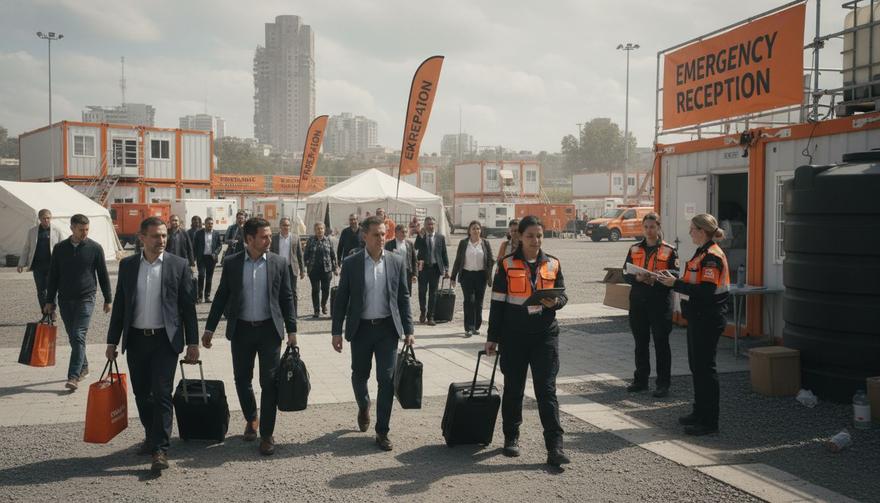
What Is Emergency Accommodation? Complete Guide 2024
Every year, sudden emergencies force millions of people and businesses out of their homes and offices with little warning. When disaster strikes, reliable emergency accommodation can mean the difference between chaos and stability. Over 80 percent of displaced individuals depend on rapid-response shelter solutions to weather the first critical hours and days. This article brings clarity to what emergency accommodation really involves and outlines practical options for those facing life’s most unexpected disruptions.
Table of Contents
- Defining Emergency Accommodation Solutions
- Types of Emergency Accommodation for Businesses
- How Emergency Accommodation Works
- Eligibility, Access, and Booking Processes
- Legal Standards, Safety, and Compliance
- Comparing Emergency Accommodation Alternatives
Key Takeaways
| Point | Details |
|---|---|
| Emergency Accommodation Focus | Designed to provide immediate shelter and support during crises, prioritizing human dignity and safety. |
| Business Solutions | Includes various types such as portable buildings and corporate housing, tailored for operational continuity during disruptions. |
| Eligibility Criteria | Access relies on specific needs assessments and verification processes to ensure resources reach those most in need. |
| Legal and Safety Standards | Adheres to comprehensive guidelines that ensure safety, privacy, and dignified treatment for those utilizing emergency accommodation. |
Defining Emergency Accommodation Solutions
Emergency accommodation represents a critical lifeline for individuals facing sudden displacement or crisis situations, offering temporary shelter and immediate protection when standard housing becomes unavailable. These solutions go beyond mere physical space, providing a fundamental safety net during challenging life transitions.
Emergency shelters serve multiple crucial functions for different populations experiencing unexpected challenges. Key scenarios where emergency accommodation becomes essential include:
- Natural disaster displacement
- Domestic violence situations
- Sudden homelessness
- Refugee or asylum seeker resettlement
- Post-conflict zone emergency relocation
At its core, emergency accommodation aims to deliver more than just a roof overhead. The corporate venue finding guide highlights that these solutions must prioritize human dignity, safety, and basic physiological needs. The United Nations High Commissioner for Refugees (UNHCR) emphasizes that effective emergency shelters must be adaptable to specific geographical, cultural, and climatic contexts.
Understanding emergency accommodation requires recognizing its temporary yet transformative nature. These spaces are not permanent housing solutions but critical interim environments designed to provide immediate protection, security, and basic human requirements during life’s most unpredictable moments. Whether supporting individuals fleeing domestic violence, recovering from natural disasters, or navigating sudden economic challenges, emergency accommodation represents a compassionate societal response to human vulnerability.
Types of Emergency Accommodation for Businesses
Emergency accommodation solutions for businesses encompass a diverse range of temporary housing and workspace options designed to provide rapid, flexible response during unexpected disruptions. These solutions are critical for maintaining operational continuity and supporting employee welfare during challenging transitional periods.
Businesses have several strategic emergency accommodation types at their disposal:
- Portable Buildings : Quickly deployable structures that serve as temporary offices, storage units, or staff accommodations
- Corporate Housing : Fully furnished apartments or residential spaces for relocating employees
- Hotel Block Reservations : Pre-arranged accommodation for teams during emergency situations
- Serviced Office Spaces : Immediately available professional environments with essential infrastructure
- Remote Work Transition Spaces : Flexible locations supporting sudden workplace displacement
When exploring emergency accommodation, companies must consider multiple factors. Selecting the right venue for corporate events provides insights into matching accommodation needs with specific organizational requirements. Portable buildings , as highlighted in research, offer remarkable flexibility, enabling businesses to quickly establish functional spaces that can be relocated or reconfigured as needed.
Intelligent emergency response systems are transforming how businesses approach accommodation solutions. Advanced technologies now enable real-time sensor monitoring and AI-driven adaptability, allowing organizations to create more responsive, efficient emergency accommodation strategies.
This technological evolution means businesses can now access more dynamic, intelligent temporary housing options that seamlessly integrate with their operational continuity plans.
How Emergency Accommodation Works
Emergency accommodation operates as a complex, adaptive system designed to provide immediate shelter and support during critical transitions, functioning through a structured network of resources, partnerships, and responsive protocols that ensure rapid assistance for individuals and organizations facing unexpected disruptions.
The operational mechanics of emergency accommodation typically involve several key stages:
- Initial Assessment : Rapid evaluation of specific accommodation needs
- Resource Allocation : Matching available spaces with urgent requirements
- Immediate Placement : Quick transition into temporary housing
- Support Services : Providing additional assistance beyond physical shelter
- Transition Planning : Developing strategies for long-term stability
Selecting the right corporate venue reveals that successful emergency accommodation relies on strategic partnerships and pre-established networks. Local authorities, nonprofit organizations, and private providers collaborate to create flexible, responsive systems that can quickly mobilize resources when standard housing becomes unavailable.
For businesses and individuals alike, the effectiveness of emergency accommodation hinges on its ability to provide more than just a temporary roof. These solutions integrate comprehensive support mechanisms, including safety protocols, psychological assistance, and practical resources designed to help individuals or organizations navigate challenging transitions. Whether addressing corporate displacement, personal emergencies, or unexpected workforce relocations, emergency accommodation represents a dynamic, human-centered approach to providing immediate stability during life’s most unpredictable moments.
Eligibility, Access, and Booking Processes
Emergency accommodation eligibility represents a complex landscape of carefully defined criteria designed to ensure that limited resources reach those most critically in need. Organizations and individuals seeking emergency housing must navigate a structured process that evaluates specific circumstances, urgency, and potential support requirements.
Typical eligibility criteria for emergency accommodation often include:
- Demonstrable immediate housing need
- Proof of displacement or crisis situation
- Verification of current living circumstances
- Assessment of personal or organizational vulnerability
- Financial hardship documentation
- Potential risk factors requiring urgent intervention
Corporate venue selection strategies highlight the importance of understanding comprehensive booking processes. For businesses and individuals, accessing emergency accommodation typically involves a multi-step verification procedure that includes initial inquiry, needs assessment, documentation submission, and rapid placement coordination.
The booking process for emergency accommodation is designed to be both compassionate and efficient. Modern systems leverage technology to streamline applications, allowing for quick turnaround times and minimizing additional stress during challenging transitions. Providers prioritize creating accessible pathways that balance thorough assessment with the urgent nature of emergency housing needs, ensuring that those requiring immediate shelter can navigate the system with dignity and minimal bureaucratic complexity.
Legal Standards, Safety, and Compliance
Legal standards for emergency accommodation represent a critical framework designed to protect vulnerable individuals and organizations during challenging transitions, establishing comprehensive guidelines that ensure safety, dignity, and fundamental human rights across diverse emergency housing scenarios.
Key legal compliance requirements typically encompass:
- Minimum spatial standards per occupant
- Structural integrity and building safety regulations
- Accessibility provisions for diverse populations
- Health and hygiene infrastructure requirements
- Privacy protection protocols
- Non-discriminatory admission practices
- Emergency evacuation and safety planning
- Documented risk management procedures
Corporate venue selection strategies underscore the importance of understanding comprehensive legal frameworks. The United Nations High Commissioner for Refugees (UNHCR) emphasizes that emergency shelters must not only provide physical protection but also maintain human dignity through carefully designed spatial and contextual considerations.
Modern emergency accommodation legal standards go beyond traditional compliance, integrating sophisticated risk assessment, technological monitoring, and adaptive response protocols. These evolving frameworks recognize that safety is not just about physical infrastructure but encompasses psychological well-being, cultural sensitivity, and holistic support mechanisms. By establishing rigorous yet compassionate standards, emergency accommodation providers create environments that protect, respect, and empower individuals and organizations during their most vulnerable moments.
Comparing Emergency Accommodation Alternatives
Emergency accommodation alternatives represent a complex ecosystem of solutions, each designed to address unique organizational and individual needs during critical transition periods. Understanding the nuanced differences between these options becomes crucial for making informed decisions that balance practical requirements with human-centered support.
Key emergency accommodation alternatives include:
- Hotel and Temporary Lodging Pros: Immediate availability, professional environmentCons: Higher cost, limited customization
- Corporate Housing Pros: Fully furnished, home-like atmosphereCons: Potential longer-term commitment
- Portable Modular Structures Pros: Rapid deployment, flexible configurationCons: Initial setup complexity
- Serviced Apartments Pros: Extended stay capabilities, amenity accessCons: Limited location options
- Remote Work Transition Spaces Pros: Technology-enabled, adaptable environmentsCons: Potential connectivity challenges
Hotel and Temporary Lodging
- Pros: Immediate availability, professional environment
- Cons: Higher cost, limited customization
Corporate Housing
- Pros: Fully furnished, home-like atmosphere
- Cons: Potential longer-term commitment
Portable Modular Structures
- Pros: Rapid deployment, flexible configuration
- Cons: Initial setup complexity
Serviced Apartments
- Pros: Extended stay capabilities, amenity access
- Cons: Limited location options
Remote Work Transition Spaces
- Pros: Technology-enabled, adaptable environments
- Cons: Potential connectivity challenges
Corporate venue selection strategies demonstrate that choosing the right emergency accommodation requires careful evaluation of specific organizational contexts. Academic research increasingly highlights the importance of scenario-based approaches when comparing alternative solutions.
Advanced emergency accommodation strategies now incorporate sophisticated assessment frameworks that go beyond traditional binary comparisons. These emerging models consider multi-dimensional factors including technological adaptability, psychological support infrastructure, cost-effectiveness, and long-term resilience. By developing nuanced, contextually sensitive evaluation methods, organizations can design more responsive, human-centered emergency accommodation solutions that seamlessly adapt to unpredictable challenges.
Secure Responsive Emergency Accommodation with Jigsaw Conferences
Navigating the complex demands of emergency accommodation calls for solutions that combine speed, safety and flexibility. The challenges outlined in the article such as rapid displacement, urgent housing needs and legal compliance can overwhelm businesses and individuals seeking reliable shelter options. When immediate, adaptable spaces are essential, Jigsaw Conferences offers expert assistance in securing tailored corporate housing and emergency venues that prioritise dignity and operational continuity.
Whether you require quick deployment of portable buildings, serviced office spaces or coordinated hotel block reservations, our extensive experience since 2003 ensures you access cost-effective, vetted solutions. Explore how our venue finding services can simplify your emergency accommodation booking process and provide peace of mind. Don’t wait until disruption hits. Take action now by contacting Jigsaw Conferences to benefit from free personalised support designed to protect your people and business continuity in moments that demand it.
Frequently Asked Questions
What is emergency accommodation?
Emergency accommodation refers to temporary housing solutions provided to individuals or organizations facing sudden displacement due to crises, such as natural disasters, domestic violence, or unexpected relocations.
What types of emergency accommodation are available for businesses?
Businesses can access various emergency accommodation types, including portable buildings, corporate housing, hotel block reservations, serviced office spaces, and remote work transition spaces, each catering to specific needs during disruptions.
How does the booking process for emergency accommodation work?
The booking process typically involves a multi-step verification that includes an initial inquiry, needs assessment, documentation submission, and rapid placement coordination aimed at ensuring quick access to shelter during emergencies.
What legal standards apply to emergency accommodation?
Legal standards for emergency accommodation include requirements for minimum space per occupant, building safety regulations, accessibility provisions, and safety planning, all aimed at protecting the dignity and rights of individuals in crisis.
Recommended
- Venue sourcing explained: streamline your corporate event planning | Jigsaw Conferences
- Find flexible temporary event spaces for UK corporate gatherings | Jigsaw Conferences
- Find the ideal upscale wedding venue for UK events | Jigsaw Conferences
- Efficient strategies for long-stay business travel in the UK | Jigsaw Conferences
- Venue contracts: Essential guide for UK corporate events | Jigsaw Conferences
Jigsaw Conferences Editorial Team
Verified AuthorThe Jigsaw Conferences Editorial Team comprises venue finding experts with over 20 years of combined experience in the events and hospitality industry. Our team includes certified meeting professionals (CMP), venue sourcing specialists, and industry analysts who provide authoritative insights on venue selection, event planning, and corporate accommodation.