
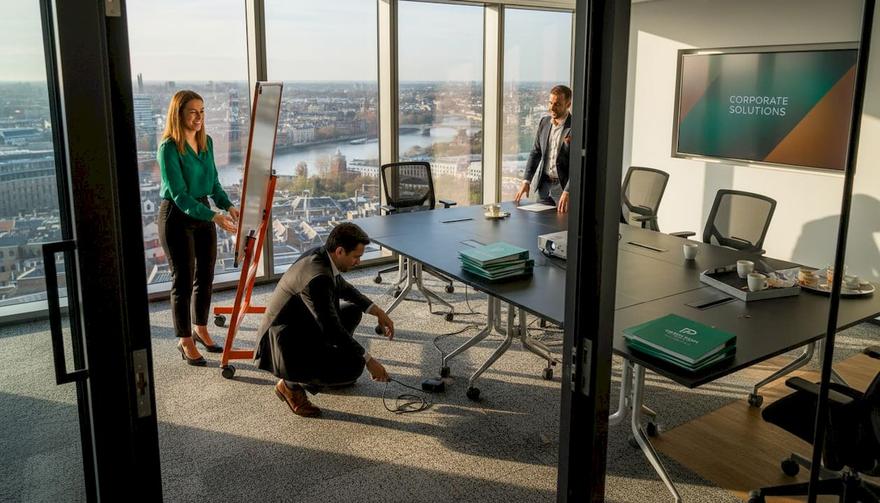
Flexible meeting spaces for better UK corporate events
TL;DR: Flexible meeting spaces adapt to various formats and can reconfigure quickly and easily.Location, technology, capacity, and catering are key criteria for selecting flexible venues.They enable innovative event formats and hybrid experiences that enhance delegate engagement.
TL;DR:
- Flexible meeting spaces adapt to various formats and can reconfigure quickly and easily.
- Location, technology, capacity, and catering are key criteria for selecting flexible venues.
- They enable innovative event formats and hybrid experiences that enhance delegate engagement.
Booking a venue that fights your agenda rather than supporting it is one of the most frustrating experiences in corporate event planning. You arrive expecting theatre-style seating for 80 delegates, only to discover that the room cannot be reconfigured once the chairs are laid out. Worse still, your afternoon breakout session has nowhere to go. Flexible meeting spaces solve this problem at the root. They adapt to your programme, not the other way around. This article walks you through the key selection criteria, highlights standout UK venues, compares features side by side, and gives you situational guidance to match the right space to every type of corporate event you organise.
Table of Contents
- Criteria for choosing flexible meeting spaces
- Top flexible meeting spaces across the UK
- Comparing flexible meeting spaces: features and benefits
- Making the right choice: situational recommendations
- The overlooked potential of flexible meeting spaces
- How Jigsaw Conferences helps you find your perfect space
- Frequently asked questions
Key Takeaways
| Point | Details |
|---|---|
| Flexibility boosts engagement | Adaptable spaces allow for dynamic agendas and greater attendee participation. |
| UK offers diverse options | From temporary venues to creative spaces, there is a flexible solution for every corporate event. |
| Criteria matter | Assessing venue location, technology, and scalability ensures your gathering runs smoothly. |
| Comparisons save time | Side-by-side features help planners quickly narrow down the best options. |
| Expert help is available | Specialist venue finders streamline selecting flexible spaces for any event size or style. |
Criteria for choosing flexible meeting spaces
Now that we have framed the challenge, let us define how to select truly flexible meeting spaces.
Not every venue that markets itself as “flexible” actually delivers on that promise. The word is used loosely in the industry, so you need a clear framework before you start shortlisting. Here are the factors that genuinely distinguish a flexible venue from one that merely looks the part on a brochure.
Location and accessibility matter more than planners sometimes admit. A venue with superb layout options loses much of its value if half your delegates spend an hour searching for parking or cannot reach it by public transport. Prioritise venues within walking distance of major rail stations or with dedicated shuttle links, particularly for events drawing attendees from across the country.
Room layout adaptability is the core test. A genuinely flexible space adapts to varied event formats , shifting between boardroom, cabaret, classroom, and theatre configurations with minimal effort and cost. Ask venues specifically how quickly a room can be turned around between sessions, and whether that service is included in the day delegate rate or charged separately.
Technological amenities are non-negotiable in 2026. Look for venues with integrated AV systems, high-speed Wi-Fi that can handle simultaneous streaming, hybrid conferencing capabilities, and reliable technical support on site. A venue that requires you to bring in your own AV contractor adds cost and complexity.
Capacity and scalability should always be verified against your worst-case scenarios. Will the venue accommodate a 20% increase in delegates if sign-ups exceed expectations? Can a large plenary space be subdivided for parallel workshops? These are the questions that expose inflexibility early.
Catering and breakout options round out the picture. Refreshment breaks that keep delegates on the same floor as the main room save time and reduce the risk of a session running late. Breakout rooms adjacent to the main hall are far preferable to spaces on a different floor or building.
Key criteria at a glance:
- Proximity to transport hubs and parking
- Speed and cost of room reconfiguration
- Integrated AV and hybrid meeting technology
- Scalable capacity for unexpected growth
- On-floor catering and breakout adjacency
- Clear policies on last-minute layout changes
You can find detailed meeting room selection tips that expand on each of these points with real examples from UK corporate planners.
Pro Tip: Always ask the venue coordinator to walk you through their room-change policy in writing before you sign a contract. Some venues charge a premium for layout alterations requested less than 48 hours before the event, which can significantly affect your contingency budget.
Top flexible meeting spaces across the UK
With the criteria in mind, let us explore UK venues best equipped to meet your needs.
The UK market for flexible meeting venues has matured considerably over the past decade. A growing number of spaces now offer modular room systems, pop-up configurations, and hybrid event infrastructure as standard. Venues provide tailored solutions particularly suited to professional services firms whose event requirements shift from quarter to quarter.
Here is a curated overview of venue types and specific examples worth exploring:
- Business design centres in London, such as those in Islington and Southwark, offer large open-plan floors that can be divided into multiple configurations using moveable acoustic partitions. They work especially well for product launches that transition into networking receptions.
- Hotel conference facilities in Birmingham and Manchesterfrequently provide the highest delegate capacity per pound spent, with day delegate packages that include AV, catering, and room changes within a defined window. The NEC area in Birmingham, for instance, has several four-star hotels with purpose-built conference wings capable of hosting 20 to 500 delegates.
- Civic and cultural venues, including converted warehouses and arts centres across cities like Bristol, Leeds, and Sheffield, offer distinctive environments that traditional office-park hotels cannot match. Their open-plan layouts lend themselves to unconventional seating arrangements that encourage dialogue rather than passive listening.
- Serviced meeting suitesfrom operators like Regus, IWG, and independent boutique providers have expanded rapidly across regional cities. These are particularly strong for smaller gatherings of 10 to 30 people where speed of booking and flexibility of contract terms are paramount.
- University conference facilities, available during term breaks and increasingly year-round, provide excellent value and often feature purpose-built lecture theatres alongside seminar rooms, giving planners genuine variety within a single campus.
- Purpose-built training centresattached to larger corporate campuses are sometimes available for hire and come pre-equipped with syndicate rooms, breakout pods, and catering. These suit training events particularly well because the infrastructure is already calibrated for learning environments.
Business design centres in London , such as those in Islington and Southwark, offer large open-plan floors that can be divided into multiple configurations using moveable acoustic partitions. They work especially well for product launches that transition into networking receptions.
Hotel conference facilities in Birmingham and Manchester frequently provide the highest delegate capacity per pound spent, with day delegate packages that include AV, catering, and room changes within a defined window. The NEC area in Birmingham, for instance, has several four-star hotels with purpose-built conference wings capable of hosting 20 to 500 delegates.
Civic and cultural venues , including converted warehouses and arts centres across cities like Bristol, Leeds, and Sheffield, offer distinctive environments that traditional office-park hotels cannot match. Their open-plan layouts lend themselves to unconventional seating arrangements that encourage dialogue rather than passive listening.
Serviced meeting suites from operators like Regus, IWG, and independent boutique providers have expanded rapidly across regional cities. These are particularly strong for smaller gatherings of 10 to 30 people where speed of booking and flexibility of contract terms are paramount.
University conference facilities , available during term breaks and increasingly year-round, provide excellent value and often feature purpose-built lecture theatres alongside seminar rooms, giving planners genuine variety within a single campus.
Purpose-built training centres attached to larger corporate campuses are sometimes available for hire and come pre-equipped with syndicate rooms, breakout pods, and catering. These suit training events particularly well because the infrastructure is already calibrated for learning environments.
Explore top spaces for corporate functions and a detailed guide to flexible conference rooms to build a more comprehensive longlist for your next event.
Pro Tip: When booking creative or unconventional venues for training sessions, always check the acoustic performance of the space. Open-plan venues that look impressive can create noise bleed between breakout groups, which undermines concentration and learning outcomes significantly.
Comparing flexible meeting spaces: features and benefits
Next, let us see the venues compared side by side to streamline your decision-making.
Raw information about individual venues is useful, but corporate planners typically need to weigh multiple options against each other under time pressure. The table below maps the most common venue categories against the criteria that matter most for flexible corporate events.
| Venue type | Layout flexibility | Hybrid tech | Catering on site | Relative cost | Best suited for |
|---|---|---|---|---|---|
| Business design centre | Very high | Standard | Full service | High | Large conferences, launches |
| City centre hotel | High | Advanced | Full service | Medium to high | All formats, 20 to 500 delegates |
| Civic or cultural venue | High | Variable | Partial or external | Medium | Creative formats, networking |
| Serviced meeting suite | Medium | Good | Light catering | Low to medium | Smaller meetings, training |
| University facility | Medium | Basic to good | Full service | Low | Training, seminars, workshops |
| Purpose-built training centre | Very high | Advanced | Full service | Medium | Training, modular workshops |
City centre hotels consistently score highest on overall adaptability because they combine professional AV, scalable catering, and room configuration options under one roof with a dedicated events team. However, creative spaces notably enhance meeting engagement , which means that for events where delegate participation and energy levels are critical, a civic or cultural venue can outperform a conventional hotel despite offering fewer logistical guarantees.
“The most memorable and productive meetings we facilitate are almost never in conventional hotel ballrooms. They happen in spaces that surprise delegates as soon as they walk through the door. Novelty primes the brain for new thinking, and that is exactly what forward-looking corporate events need to achieve.”
“The most memorable and productive meetings we facilitate are almost never in conventional hotel ballrooms. They happen in spaces that surprise delegates as soon as they walk through the door. Novelty primes the brain for new thinking, and that is exactly what forward-looking corporate events need to achieve.”
For events where budget is tight but adaptability still matters, small space rentals offer an underappreciated middle ground. Many boutique providers allow you to combine two adjacent rooms at short notice, giving you the effect of a larger plenary space without committing to full venue hire.
When reading the comparison table, resist the temptation to focus only on cost. A cheaper venue that cannot adapt to your programme mid-event will cost you far more in delegate time and reputation than the price difference ever justified. Treat flexibility as a non-negotiable baseline, then optimise for cost within that constraint.
Making the right choice: situational recommendations
Having compared venues, here is how to tailor your selection for maximum impact.
The framework above gives you the criteria and the comparisons. Now you need a decision process that translates those insights into a concrete venue choice for your specific event. Follow these steps in order, and you will significantly reduce the risk of a costly mismatch.
- Define your event format first. Before you look at a single venue, confirm whether your event is primarily a plenary session, a training workshop, a board meeting, or a hybrid of formats. This single decision eliminates the majority of unsuitable venues immediately.
- Set your capacity range. Use a minimum and maximum figure rather than a single number. Build in at least a 15% buffer above your expected headcount to account for late registrations.
- Audit your technology requirements. List every piece of AV or connectivity infrastructure your programme needs, including live streaming, audience response systems, and video conferencing links. Share this list with the venue before visiting.
- Shortlist by location logic. Map the travel origins of your delegate group and choose a venue that minimises total travel time across the group, not just travel time for the organiser.
- Check reconfiguration terms in writing. Confirm how many layout changes are included, the turnaround time, and any additional charges. For events with shifting formats across a full day, this clause can make or break your logistics.
- Request a site visit on an event day. Seeing a venue during someone else’s event reveals how the staff actually perform under pressure, which is far more informative than a quiet inspection visit.
For events that need temporary conference rooms with flexible solutions, temporary spaces are ideal for fast-changing requirements, giving you the ability to scale up or down without being locked into a long-term venue relationship.
The table below provides quick situational guidance to match your event type with the most appropriate venue category.
| Event type | Recommended venue | Key reason |
|---|---|---|
| Board meeting (under 20 people) | Serviced meeting suite or boutique hotel | Discretion, high-spec AV, easy booking |
| Training session (20 to 60 people) | Purpose-built training centre or university | Syndicate rooms, learning-focused setup |
| Conference (60 to 300 people) | City centre hotel or business design centre | Scalable rooms, full catering, on-site tech |
| Seminar with networking | Civic or cultural venue | Distinctive environment, open layout |
| Hybrid event | City centre hotel with advanced AV | Integrated streaming, reliable connectivity |
Comprehensive guidance on choosing a conference venue is available for planners working through this process for the first time, and the Manchester conference venues guide is an excellent resource if the North West is your target region.
The overlooked potential of flexible meeting spaces
Most articles on this topic stop at logistics. They help you tick boxes. What they rarely address is the strategic opportunity that flexible spaces create for planners willing to rethink the format of corporate events altogether.
The conventional half-day conference, with a keynote followed by panel discussion and a buffet lunch, persists largely because rigid venues make it easy to default to. When you remove that architectural constraint, entirely different formats become viable. Rotating roundtables. Fishbowl discussions. Speed-networking structures that move people around the room every 12 minutes. These approaches generate measurably higher delegate satisfaction and retention, yet they require a venue that can accommodate movement, noise, and rapid reconfiguration.
Pop-up spaces and temporary event spaces are accelerating this shift. They allow organisations to hold events in locations that are meaningful to the business, a client site, an innovation hub, a rooftop terrace, rather than always defaulting to a hotel meeting room.
Hybrid events have added a further dimension. A venue that handles the physical experience well but delivers a mediocre streaming environment effectively excludes a significant portion of your audience. Flexibility now means flexibility across both physical and digital planes simultaneously.
“Flexible venues are not a logistical convenience. They are a strategic enabler. The organisations that treat them as such will consistently outperform those that see venue selection as an administrative task.”
“Flexible venues are not a logistical convenience. They are a strategic enabler. The organisations that treat them as such will consistently outperform those that see venue selection as an administrative task.”
The future belongs to planners who treat the venue as part of the event design, not just its container.
How Jigsaw Conferences helps you find your perfect space
Now that you know what to look for, here is how to find the perfect flexible space with expert help.
Jigsaw Conferences has been matching corporate clients with the right venues since 2003, which means our team has built relationships across the full spectrum of UK flexible meeting spaces, from boutique serviced suites to large-scale conference centres. We understand that your requirements rarely fit neatly into a standard package, which is why our approach is built around understanding your specific programme, delegate profile, and budget before we make a single recommendation. Our venue finder gives you instant access to a curated database of flexible spaces across the UK, with the added benefit of our negotiating power to secure competitive rates. Best of all, the service is completely free to use. Let us take the shortlisting work off your desk so you can focus on the event itself.
Frequently asked questions
What makes a meeting space flexible?
A flexible meeting space can be reconfigured or adapted easily to suit different event formats, capacities, and technological needs, typically through moveable partitions, modular furniture, and scalable AV systems.
How can I find venues catering to last-minute changes?
Venues offering temporary or modular rooms are best equipped for last-minute adjustments, ensuring your event stays agile even when delegate numbers or programme requirements shift at short notice.
Are flexible meeting spaces cost-effective for small events?
Yes. Small space rentals are tailored to meet event size, meaning you pay only for the rooms and features you actually use rather than subsidising capacity you do not need.
Which UK cities have the best selection of flexible venues?
Major cities including London, Manchester, and Birmingham offer the widest selection of flexible meeting spaces for corporate requirements, with Manchester in particular covered in depth by a dedicated corporate events guide.
Jigsaw Conferences Editorial Team
Verified AuthorThe Jigsaw Conferences Editorial Team comprises venue finding experts with over 20 years of combined experience in the events and hospitality industry. Our team includes certified meeting professionals (CMP), venue sourcing specialists, and industry analysts who provide authoritative insights on venue selection, event planning, and corporate accommodation.